

The Complete Guide to the 4Cs for Colombian Emeralds
Colombian emeralds sit at the top of the emerald market for one reason: no other source on earth consistently produces stones with the same depth of colour and character. But understanding that a stone comes from Colombia is only the starting point. To evaluate what you are actually buying and to understand why two stones with identical laboratory paperwork can carry very different market values you need to understand how the four quality factors interact specifically in Colombian material.
The 4Cs framework was developed for diamonds by the Gemological Institute of America (GIA). Applying it to emeralds requires significant adjustment, because emeralds operate by fundamentally different rules. Emeralds are classified by the GIA as Type III gemstones, meaning that virtually all of them form with internal inclusions and surface-reaching fractures as a natural consequence of their geological origin. The standards, the trade-offs, and the priorities are different from what most buyers expect going in and the gap between expectation and reality is where most purchasing mistakes happen.
This guide walks through each of the 4Cs as they apply specifically to Colombian emeralds, explains how professional graders and reputable laboratories assess each factor, incorporates the scientific and gemological research that underpins those assessments, and gives you the knowledge to ask the right questions before you purchase.
DEALER INSIGHT
What We Look for Before Anyone Sees the Loupe
When a stone comes across our desk, the first evaluation happens before any magnification. We hold it face-up in daylight and ask a simple question: does this stone have presence?
Presence is not a technical term. It is the quality that makes a fine Colombian emerald immediately distinguishable from a stone that passes grading standards but fails to excite. It is the combination of colour saturation, transparency, and what the trade calls "life" the way the stone moves light around its interior and returns it to the eye in a saturated, vivid green. Most Colombian emeralds do not have it. The minority that do is what we source.
Everything that follows in this guide is the technical framework that explains why presence happens or doesn't. But presence is the test that comes first.
Why Colombian Emeralds Are Graded Differently
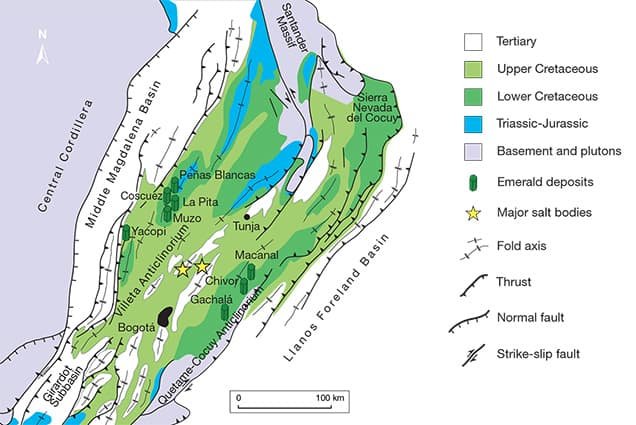
Colombian emeralds form in hydrothermal veins within black shale and limestone sedimentary deposits, in a process fundamentally different from how emeralds form in the schist-hosted deposits of Zambia, Brazil, and Russia. The three principal mining regions Muzo, Coscuez, and Chivor each sit within Colombia's Eastern Cordillera mountain range and produce stones with subtly different characteristics that experienced dealers can recognise, though no characteristic is individually diagnostic of a specific mine.
The green colour in Colombian emeralds is driven primarily by chromium (Cr), with vanadium (V) also contributing in varying proportions. Critically, Colombian emeralds are chemically distinguished from those of other origins by their exceptionally low iron (Fe) content. Published research in the GIA's peer-reviewed journal Gems & Gemology confirms that Colombian emeralds possess the lowest iron concentrations of any major emerald source. This low iron content is one reason Colombian stones display such a pure, warm green: iron introduces blue or grey interference that mutes saturation, and its near-absence in Colombian material allows the chromium-driven colour to dominate cleanly.
Because the formation environment was rich in mineralising fluids, Colombian emeralds almost universally form with a characteristic internal landscape liquid-filled cavities, crystals of carbonates, pyrite, quartz, and the saline solutions of the hydrothermal environment. Collectively, the trade describes this internal world using the French term jardin (garden). A jardin is not automatically a defect. In Colombian emeralds, a well-formed jardin is evidence of origin and natural formation and in some grading frameworks, a complex but non-intrusive jardin can positively signal authenticity.
A Scientific Note on Colombian Origin Confirmation
One of the most misunderstood aspects of buying a Colombian emerald is what "Colombian origin confirmed" actually means and how difficult it is to establish without advanced laboratory testing.
The GIA's 2019 peer-reviewed study on emerald geographic origin determination establishes that confirming a Colombian origin requires multiple converging lines of evidence: UV-Vis-NIR spectroscopy (which shows the characteristic absence of iron-related absorption bands above 700nm in most Colombian stones), trace element chemistry obtained through LA-ICP-MS (laser ablation inductively coupled plasma mass spectrometry), and microscopic inclusion analysis. No single piece of evidence is sufficient. Even the presence of the three-phase jagged fluid inclusions that are the hallmark of Colombian material is not individually conclusive, because small jagged inclusions can also appear in emeralds from Afghanistan and China.
Two Colombian-specific features are, however, worth knowing in detail:
Parisite a calcium cerium fluorocarbonate mineral is the only inclusion mineral documented exclusively in Colombian emeralds and has never been identified in stones from any other origin (Gübelin & Koivula, 2008). When observed under magnification, its presence is a strong diagnostic indicator of Colombian origin. It is not frequently encountered, but experienced graders actively look for it.
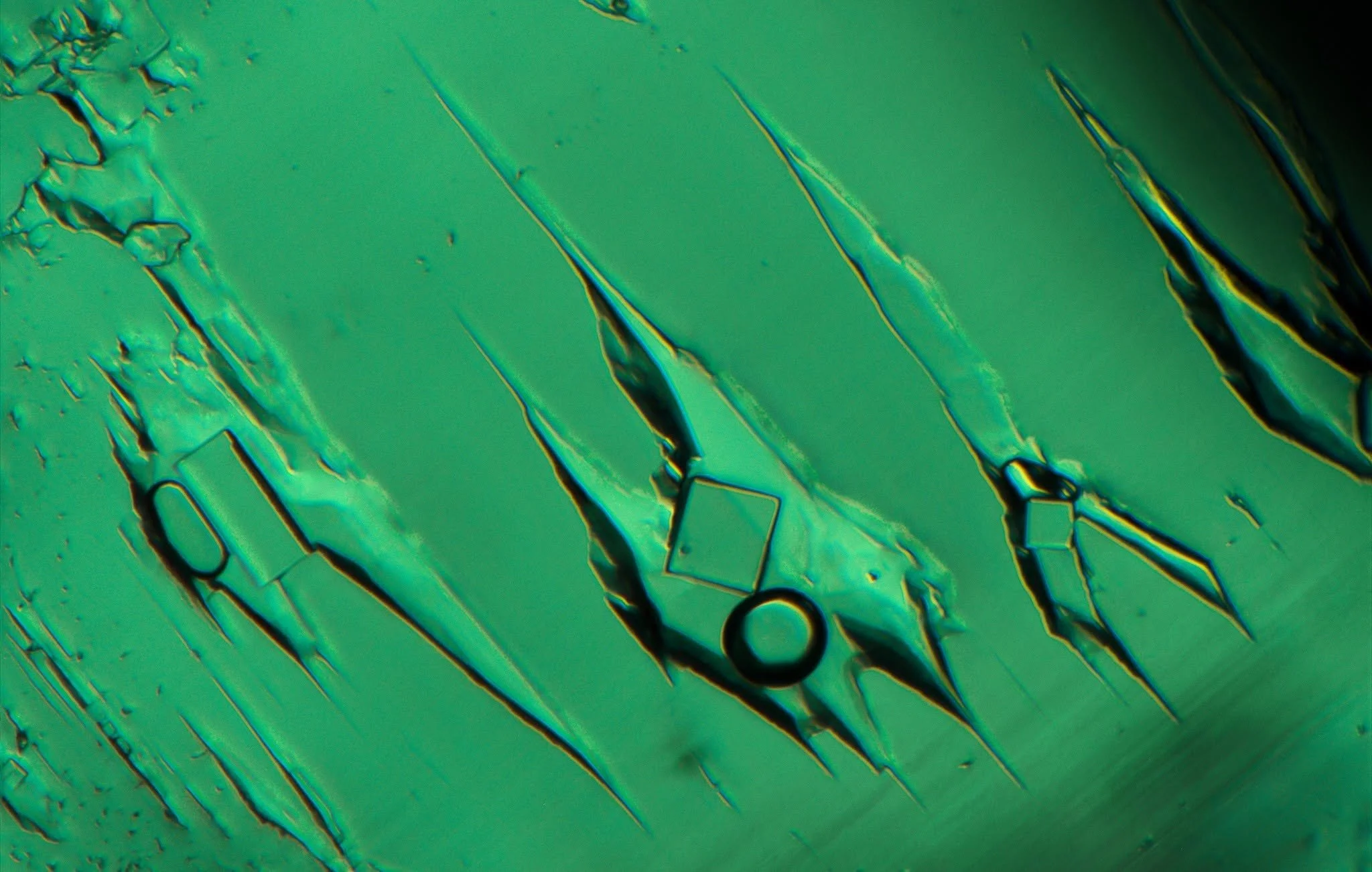
Gota de aceite (Spanish for "drop of oil") is a growth feature not an inclusion but a turbid, roiled appearance within growth planes parallel to the basal face of the crystal that is overwhelmingly characteristic of Colombian material. The GIA's 2019 research notes it is "by far most common in Colombian emeralds" among all origin types. Under magnification, it gives the stone an almost opalescent internal shimmer that is beautiful in its own right and immediately recognisable to those who know what they are seeing.
COLOUR: The Most Important of the 4Cs
Hue, Tone, and Saturation in Colombian Stones
In emerald grading, colour accounts for approximately 60 to 80 percent of a stone's assessed value — a weighting confirmed by the GIA's quality factor guidance and reflected consistently in wholesale and auction pricing. The three dimensions of colour — hue, tone, and saturation — must all align correctly for a stone to command premium pricing.
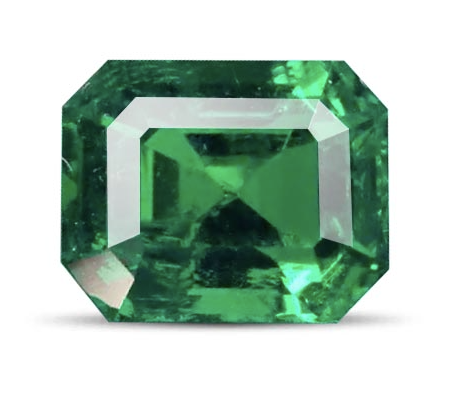
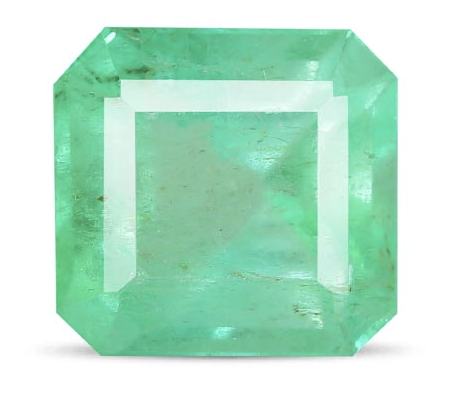
Hue is the base colour. For Colombian emeralds, the most valued hue falls within a band from pure green to very slightly yellowish green, or from pure green to very slightly bluish green. The GIA's quality factor guidance is explicit that the colour must remain definitively green: a stone that reads as yellow-green is classified as green beryl — a different gemstone with a significantly lower market value. Stones from the Muzo region tend toward a warmer, slightly more yellow-green character. Stones from Chivor tend toward a slightly cooler, blue-green character. Neither is universally preferred — they represent different aesthetic preferences that attract different buyers.
Tone describes lightness to darkness on a scale from colourless to black. The optimal tone for a fine Colombian emerald sits in the medium to medium-dark range. The GIA describes the ideal as not so dark that the stone loses luminosity, and not so light that the colour lacks depth. Stones at either extreme of the tone scale represent significant value reductions regardless of saturation.
Saturation is the vividness or intensity of the colour — freedom from grey or brown interference tones that mute the green. High saturation is where Colombian stones most consistently outperform material from other origins. The geological reason is the low iron content: iron introduces grey masking tones that reduce saturation, and its near-absence in Colombian material allows the chromium-driven green to appear clean, vivid, and uncompromised.
The trade term "vivid green," used in the highest-tier colour descriptions by major laboratories, refers to a stone where both tone and saturation are optimal. In Colombian material, this coincides with what the trade has historically called "Muzo green" or "Colombian green" — a colour standard against which all other emerald sources are measured.
How Lighting Changes What You See
A Colombian emerald should be evaluated under at least three lighting conditions before a purchasing decision is made: daylight or daylight-equivalent LED, fluorescent, and incandescent (warm) light. Daylight reveals the truest colour. Fluorescent light can flatten saturation and make inclusions more apparent useful for clarity assessment. Incandescent light is where many Colombian emeralds reveal something distinctive: a large proportion show red fluorescence under long-wave UV, and in warm candlelight conditions this can lend the stone a warmth and vibrancy that buyers who only see stones in LED lighting never experience.
This is why we offer private viewing appointments in Sydney where stones are assessed under multiple light sources. A photograph, regardless of quality, cannot replicate what happens to a fine Colombian emerald when the lighting changes.
How Origin Affects Colour Grading and Market Premium
Reputable laboratories including Gübelin Gem Lab, SSEF Swiss Gemmological Institute, and GIA now issue country-of-origin reports or origin opinions for emeralds. A Colombian origin determination confirms geological provenance — it does not automatically certify colour quality. But for comparable quality levels, Colombian origin consistently carries a market premium over material from other sources. Industry consensus and market data suggest this premium ranges from 20 to 50 percent depending on quality tier, with the premium compressing at commercial grades and expanding significantly at fine and extra-fine levels.
DEALER INSIGHT
What "Muzo Green" Actually Looks Like and Why It Matters
The term "Muzo green" gets used freely in the trade, often without precision. Here is what it means in practice.
A fine Muzo green stone has a warmth to it that is perceptible even to someone with no gemological training. When you place it next to a Zambian emerald of similar saturation and tone, the Zambian stone looks slightly cooler — the iron content introduces a blue-grey cast that is subtle but real. The Colombian stone looks cleaner, more purely green, almost as if a grey filter has been removed.
What the photographs in every online listing fail to show is how this quality shifts under different light. In daylight, the saturation is vivid. Under incandescent light, the stone takes on a warmth that makes it appear almost luminous — a consequence of the low iron content and the dominance of chromium absorption, which produces a red fluorescence response that activates under warm light. It is the quality that most surprises first-time buyers when they see it in person, and most responsible for why buyers who have seen a fine Colombian stone rarely consider anything else afterwards.
CLARITY: Understanding the Jardin
Why Emerald Clarity Standards Differ from Diamond Standards
Clarity is where buyers encounter the largest adjustment from diamond thinking. In diamonds, a stone with no visible inclusions under 10x magnification is the baseline expectation for fine quality. In emeralds, applying that standard would eliminate virtually every fine stone in existence.
The GIA classifies emeralds as Type III gemstones — a classification that acknowledges inclusions as characteristic of the species, not as defects. What matters for emerald clarity is not the presence of inclusions but their nature, their location, and whether they affect the stone's structural integrity or visual appearance.
The primary clarity concerns for Colombian emeralds are:
Fractures reaching the surface: Fractures that reach the surface — these are the fractures filled with oil or resin during treatment. A stone with extensive surface-reaching fractures has lower inherent clarity and requires more treatment to achieve a clean face-up appearance.
Table-area inclusions: Inclusions in the table facet's line of sight — a concentration of visible inclusions directly under the table reduces face-up appearance significantly, even if the stone appears cleaner from the side.
Structural durability risk: Inclusions that affect structural integrity — large through-going fractures, particularly near the girdle or corners, can make a stone fragile and unsuitable for daily wear regardless of colour quality.
A Colombian emerald with a jardin that does not intrude into the table's line of sight, does not compromise structural durability, and was formed by natural mineralising fluids is correctly assessed as having acceptable clarity for its type. The jardin itself — liquid-filled cavities, carbonate crystals, pyrite, quartz — is evidence of the stone's geological authenticity. Emeralds without any inclusions are statistically extraordinary and, in the commercial market, should prompt questions rather than enthusiasm.
The Role of Clarity Enhancement: What the Labels Mean
Cedar oil treatment has been the standard for filling surface-reaching fractures in emeralds for centuries. The cedar oil has a refractive index close to that of emerald, making fractures optically less visible. It is reversible, natural, and universally accepted when disclosed. Modern treatments also include synthetic resins most commonly Opticon — which bond more durably to the fracture walls but are considered a more significant form of enhancement.
The major laboratories report clarity enhancement on a scale. The GIA uses the designations F1 (minor), F2 (moderate), and F3 (significant) to classify the degree of filling present. Gübelin and SSEF use a comparable descriptive scale of none, minor, moderate, significant, and highly significant.
Important update as of 1 November 2025: Gübelin Gem Lab discontinued the "insignificant" category from their emerald treatment reports. Stones previously described as showing "indications of insignificant clarity enhancement" are now classified as "No indications of clarity enhancement." This change aligns Gübelin's terminology with the Laboratory Manual Harmonisation Committee (LMHC) standards and effectively means that a small number of stones previously carrying a minor treatment notation now formally carry a no-treatment classification with direct implications for market value.
A stone with "none" or "no indications" of clarity enhancement is rare in Colombian material. In our experience evaluating Colombian stones across wholesale and direct sources, fewer than 5 percent of commercial-to-fine quality stones carry a no-treatment or minor-treatment classification. These stones command the highest premiums in the market. A no-oil Colombian emerald of fine colour above 2 carats is among the rarest combinations the market offers.
Emerald treatments and what they mean for buyers
DEALER INSIGHT
What Laboratory Reports Do Not Tell You
A GIA, Gübelin, or SSEF report is an essential document for any significant emerald purchase. But there are things a report does not capture that matter in the real world.
Reports are issued under controlled laboratory lighting conditions and at fixed magnification. They document what exists in the stone at a point in time. They do not tell you how the stone performs face-up in natural daylight, how the colour shifts under warm incandescent light, whether the jardin creates a visual rhythm or disruption, or how the cut interacts with the specific distribution of inclusions.
We have seen stones with excellent laboratory documentation that are, in person, unremarkable. The report correctly describes the stone — it simply does not convey what makes or breaks a stone's desirability. Conversely, we have seen stones with moderate treatment classifications that, in person, show extraordinary colour and a completely non-intrusive jardin.
The report is the starting point for verification, not the ending point for evaluation. This is one reason we offer in-person viewings: a report verifies, but only the stone itself reveals
CUT: How Cutting Decisions Affect Value
The Emerald Cut and Its Purpose
The rectangular step cut with cropped corners universally known as the emerald cut takes its name directly from its historical application to this gemstone. The geometry serves emeralds well: the broad, open table facet maximises the face-up display of colour; the step-cut facets create a reflective depth that moves colour through the stone's interior; and the cropped corners reduce mechanical leverage stress at the stone's most vulnerable points.
The GIA's quality factor guidance on cut notes several challenges specific to emerald: the prevalence of surface-reaching fractures, the brittleness of the species relative to corundum, and the critical importance of orienting the stone so the table facet maximises chromium-driven colour saturation. For stones with strong dichroism which many Colombian emeralds display the cutter must position the table perpendicular to the crystal's long axis to prioritise the face-up appearance that commands the highest market value.
Colombian emeralds also appear in oval, round, pear, cushion, and cabochon cuts. Cabochons are used for lower-clarity material where the dome shape obscures inclusions that would be more visible in a faceted cut. Among faceted cuts, ovals are the most popular alternative to the classic emerald cut.
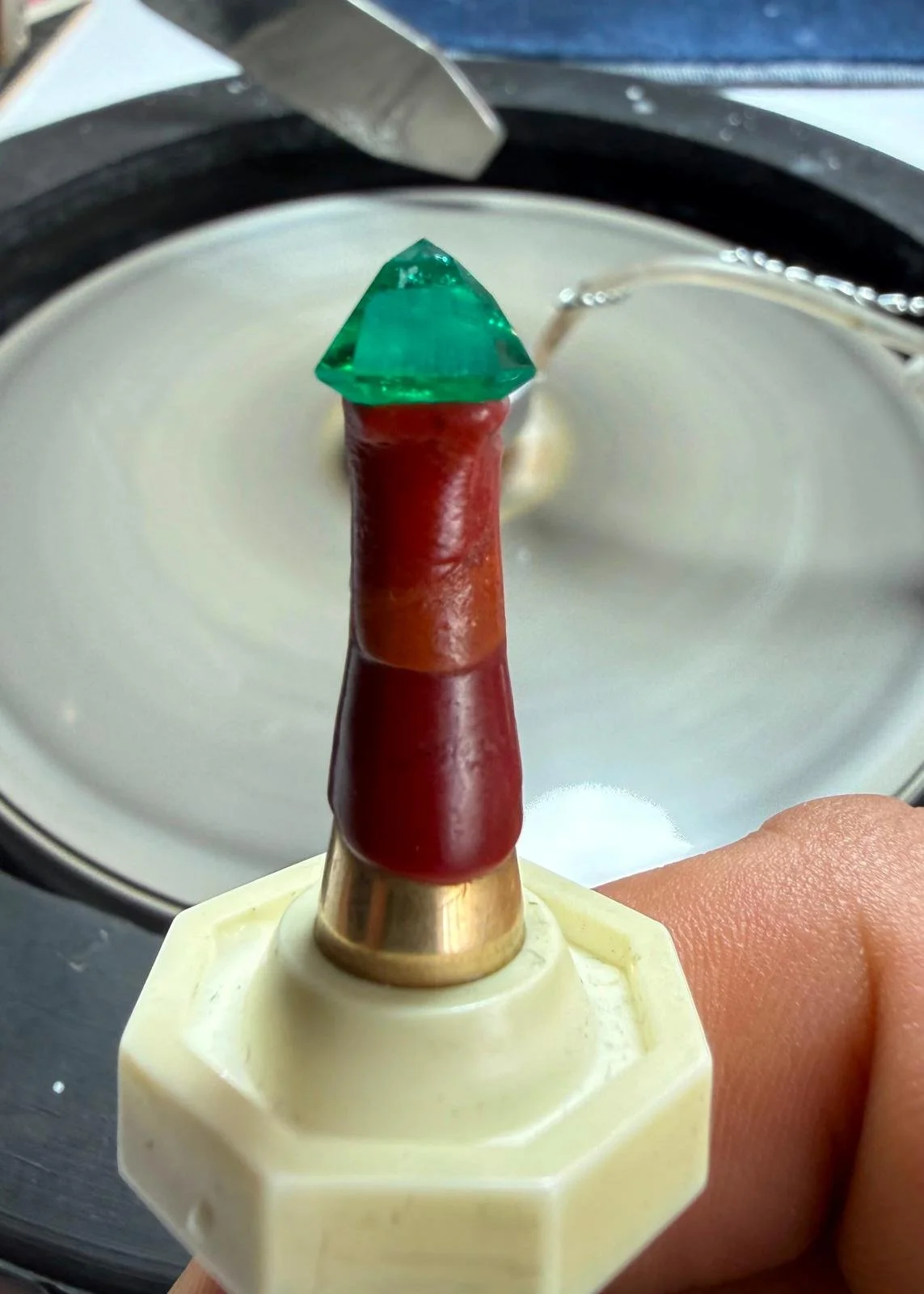
Example of a poorly cut Colombian emerald showing uneven proportions and reduced brilliance.
How Cutters Balance Colour, Weight, and Clarity
Cutting a Colombian emerald involves trade-offs that rarely exist in diamond cutting. The cutter must simultaneously:
Maximise colour saturation a stone cut too shallow will appear washed out; a stone cut too deep will appear dark and lifeless when viewed face-up.
Manage inclusion placement repositioning the rough to place visible inclusions away from the centre of the table is a core skill in emerald cutting. A skilled cutter can turn a stone that would otherwise have a compromised table into one that appears clean face-up.
Retain weight: Colombian rough is expensive at every stage of the supply chain. This consistently incentivises cutting decisions that compromise optical performance: thicker girdles, deeper pavilions, windowing through the centre, or extinction zones where light escapes without reflecting back to the eye.
In our assessment of Colombian emeralds across the full quality range, weight-retention pressure is the single most common cause of suboptimal optical performance. A well-cut stone at a given carat weight delivers significantly more visual impact than the weight figure suggests, while a weight-optimised stone often disappoints in proportion to its documentation. A correctly cut Colombian emerald shows even colour distribution across the table with no large dark extinction zones, no colourless windows in the centre, and a length-to-width ratio for the classic emerald cut between 1.3:1 and 1.5:1.
CARAT WEIGHT: Size, Rarity, and Pricing
Why Price Escalates Non-Linearly with Size
Carat weight is the standard unit of gem measurement one carat equals 0.2 grams but for Colombian emeralds, size and value do not scale proportionally. Fine-quality large stones are among the rarest objects in the gem trade, and price per carat increases exponentially rather than linearly as size increases.
A one-carat Colombian emerald of fine colour and minor treatment might trade at a given per-carat price. A three-carat stone of equivalent colour and clarity quality will not cost three times as much it will cost considerably more per carat, because the probability of finding a large, fine-quality crystal without structural compromise is exponentially lower. Stones above five carats with exceptional colour, minimal treatment, and Colombian origin confirmation from Gübelin or SSEF represent investment-grade material that rarely appears in retail markets.
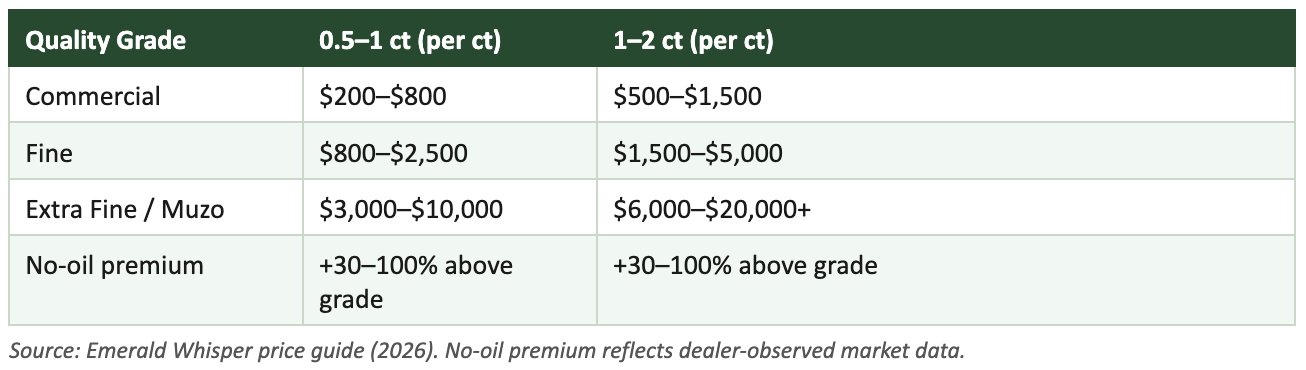
For reference, current market pricing data for Colombian emeralds by quality tier:
Carat Weight Versus Face-Up Size
Carat weight alone does not determine how large a stone appears when set and worn. Because emerald cut proportions vary widely, a 1-carat stone with ideal proportions can appear larger face-up than a 1.3-carat stone with excessive depth. When comparing stones, always request millimetre dimensions alongside carat weight and compare face-up area rather than weight.
For the classic emerald cut, a face-up length of approximately 7mm by 5mm corresponds roughly to a 1-carat stone in ideal proportions. Stones cut significantly deeper carry more of their weight hidden below the girdle, where it contributes to the weight figure but nothing to the visual impact of the mounted stone.
How the 4Cs Interact — Making Trade-Offs
No Colombian emerald simultaneously achieves exceptional ratings across every quality factor. Understanding how to prioritise — and what trade-offs make sense for your intended use is the practical core of informed emerald buying.
For jewellery in daily wear, structural durability is a real practical consideration. A stone with moderate but non-intrusive jardin and a minor-oil treatment classification is significantly more resilient than a stone with extensive surface fractures. Cedar oil treatments are routine and acceptable, but they are not permanent ultrasonic cleaning dissolves cedar oil and can significantly degrade a stone's appearance. Always ask specifically whether your stone is cedar-oil or resin treated; the care implications are different.
For a personal collection or occasional-wear piece, a fine-colour stone with a more complex jardin — particularly one with three-phase inclusions or gota de aceite features may represent outstanding value. The inclusions do not detract from enjoyment; they add geological character and authenticity.
For investment-grade purchases, treatment level becomes the primary driver after colour. The combination of Colombian origin documentation, fine colour, and no-oil or minor-oil classification defines the rarest and most durable value proposition.
Dealers and auction specialists who have long experience with Colombian material price colour first — then clarity impact, then cut quality, then carat weight. Buyers who come to the market the other way around chasing size at the expense of colour — consistently report disappointment after purchase.
DEALER INSIGHT
Common Mistakes We See Colombian Emerald Buyers Make
These are observations from real client consultations not hypothetical scenarios.
1. Trusting the photograph. Online listings routinely misrepresent colour saturation. Photographs can be taken under lights that maximise apparent saturation, processed to deepen the green, or captured at an angle that hides extinction zones. For any stone above a threshold you set for yourself, view it in person or request a video recorded in natural light conditions.
2. Assuming "certified" means "fine quality." A laboratory report verifies what is in the stone. It does not tell you whether the stone is beautiful, whether the cut is excellent, or whether the colour is commercially desirable. A mediocre stone can carry a valid Gübelin report.
3. Choosing weight over colour. A 2-carat stone with flat, desaturated colour is worth less than a 1-carat stone with exceptional saturation and presence. Every experienced dealer knows this. First-time buyers often do not.
4. Overlooking the cut. A poorly cut stone — one with a deep pavilion, visible extinction zones, or a window in the centre — is difficult to improve after the fact. Evaluate the cut carefully before purchase.
5. Not asking about treatment stability. Cedar oil treatments are routine and acceptable, but they are not permanent. Ultrasonic cleaning dissolves cedar oil treatments and can significantly degrade a stone's appearance. Ask specifically whether your stone is cedar-oil or resin treated the care implications are different.
Laboratory Reports and the 4Cs: What Documentation to Request
For any Colombian emerald above one carat or above a price threshold you set for yourself, request a laboratory report from one of the following:
Gübelin Gem Lab (Switzerland) is widely regarded as the definitive authority on emerald origin determination. Their reports combine UV-Vis-NIR spectroscopy, microscopic inclusion analysis, and LA-ICP-MS trace element chemistry to confirm origin with the highest level of scientific rigour. Gübelin reports are accepted universally in the trade, at auction, and in private transactions at the highest level. Standard turnaround is typically five business days; express options are available at major gem shows. (Gübelin Gem Lab's Colombia editorial)
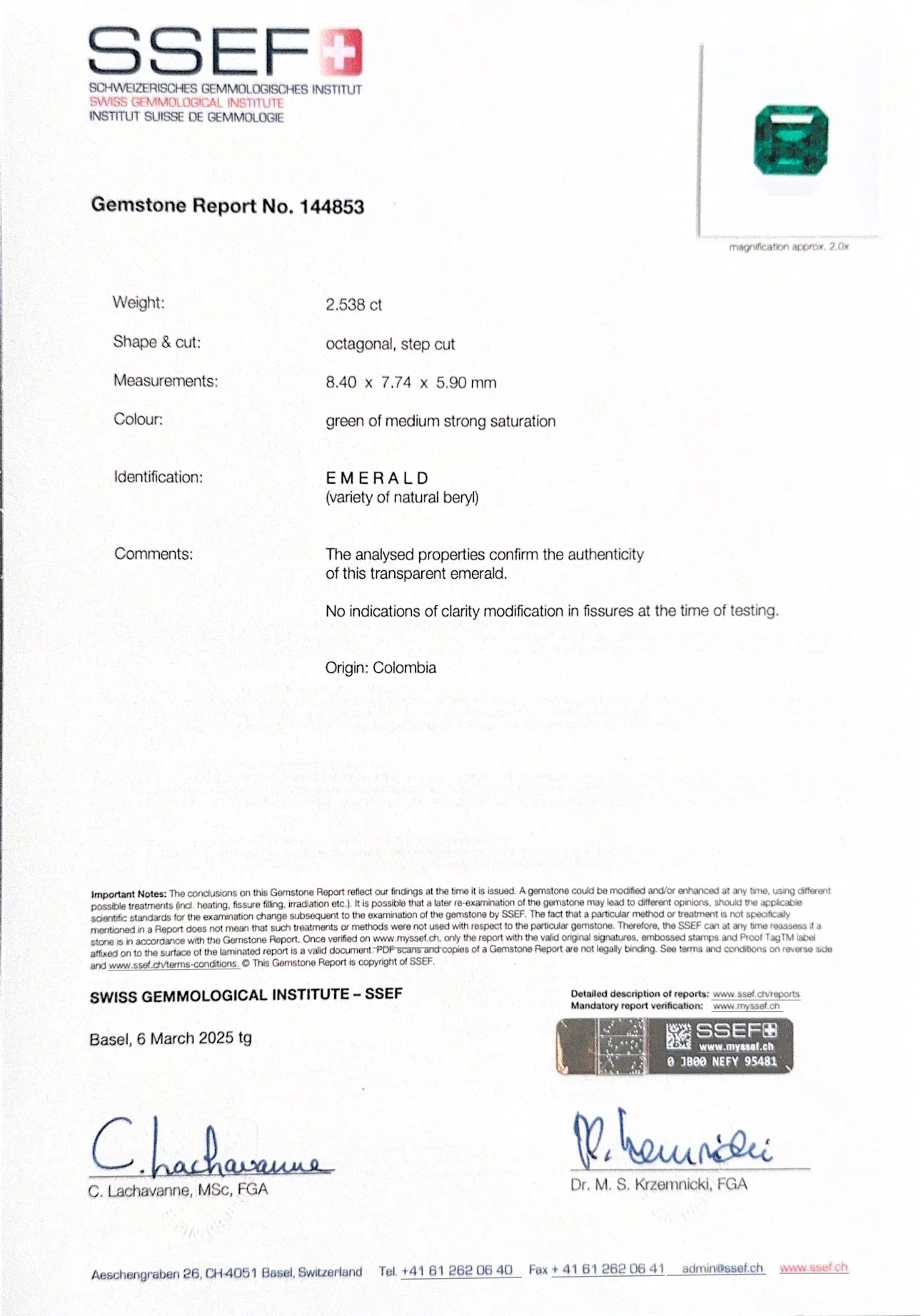
SSEF Swiss Gemmological Institute is equally respected for origin reports and treatment disclosure, with a long track record in emerald testing and published research contributions to the field. Both Gübelin and SSEF are members of the Laboratory Manual Harmonisation Committee (LMHC), which ensures their treatment terminology is aligned. (GIA Colored Stone Identification & Origin Report)
GIA (Gemological Institute of America) issues Colored Stone Identification & Origin Reports that include geographic origin opinions when requested. The GIA's methodology for origin determination is scientifically rigorous and based on published research. The distinction in market acceptance between GIA and the Swiss labs relates to the depth of specific emerald expertise and the historical weight those labs carry in the top tier of the trade — not to any scientific shortcoming in the GIA's approach. For investment-grade emeralds at the highest price tier, Gübelin or SSEF reports are the market standard. For fine-quality stones in the broader market, a GIA report with origin opinion is meaningful and respected.
A complete report should document: country of origin, colour description, clarity enhancement type and degree, carat weight, and millimetre dimensions. One more critical note: a report documents the stone as submitted at the time of testing. Verify that the stone's weight and measurable characteristics match the report exactly before completing any significant purchase. Reputable dealers will facilitate this verification without hesitation.
If you are considering purchasing a Colombian emerald and want to evaluate a stone in person, we offer private viewing appointments in Sydney. Viewing a stone under different lighting conditions — daylight, fluorescent, and incandescent — is the only reliable way to assess colour performance, face-up appearance, and the character of the jardin before buying. We bring the same evaluation approach to client viewings that we apply to our own sourcing: honest assessment of what makes a stone exceptional and what makes it ordinary.
Book a private Sydney viewing appointment or explore our current selection of certified Colombian emeralds. Every stone we offer comes with full disclosure of treatment level and, for significant stones, laboratory documentation of origin from Gübelin, SSEF, or GIA.FAQ: The 4Cs of Colombian Emeralds
Common Questions
Q: What are the 4Cs of emeralds and how do they differ from diamond grading?
The 4Cs: Colour, clarity, cut, and carat weight apply to emeralds but with different weightings. Colour drives 60–80% of value. Clarity expectations are lower because emeralds are Type III gemstones that naturally contain inclusions. Cut must balance colour maximisation, inclusion management, and weight retention rather than following standardised proportions.
Q: What is the best colour for a Colombian emerald?
The most valued colour is vivid, medium to medium-dark pure green with high saturation and no grey or brown masking tones. Muzo stones trend warmer (yellow-green); Chivor stones trend cooler (blue-green). Both are prized. The key factors are saturation and optimal tone — not so dark the stone appears muddy, not so light it appears washed out.
Q: Are inclusions in Colombian emeralds a problem?
No — inclusions are normal and expected. The internal landscape, called a jardin, is characteristic of the species. What matters is whether inclusions are visible in the table face-up, whether they compromise structural integrity, and whether they required significant treatment. Inclusions that are invisible face-up and do not affect durability are acceptable in fine-quality Colombian material.
Q: What does clarity enhancement mean for Colombian emeralds, and should I avoid treated stones?
Clarity enhancement — filling surface fractures with cedar oil or resin — is a standard, disclosed practice. The overwhelming majority of Colombian emeralds are treated to some degree. The degree of treatment is what matters. Always request laboratory documentation confirming the treatment level. Untreated or minor-oil stones are rarer and more valuable, but treated stones are not inferior by default.
Q: How do I verify that a Colombian emerald is genuine?
For stones above one carat or above a meaningful price threshold, request a laboratory report from Gübelin Gem Lab, SSEF, or GIA. A Gübelin or SSEF origin report confirms Colombian provenance through spectroscopy, trace element chemistry, and inclusion analysis. Without independent laboratory documentation, you are relying solely on the seller's representation.
Q: What is gota de aceite in Colombian emeralds?
Gota de aceite (Spanish for "drop of oil") is a growth feature found overwhelmingly in Colombian emeralds. It appears as a turbid, roiled quality within growth planes visible under magnification and is considered a strong indicator of Colombian origin. The GIA's peer-reviewed research identifies it as far more common in Colombian material than in any other emerald source.