

Colombian vs Zambian Emeralds: A Side-by-Side Comparison (2026)
By Mateo Patino | Colombian Gems, Sydney
Buyers, jewellers, and collectors regularly ask which origin produces the better stone. The honest answer is that Colombian and Zambian emeralds are genuinely different — not ranked. Each origin produces stones with distinct optical and chemical characteristics that are measurable in the laboratory and visible in person. The right choice depends on what you are looking for, how you are using the stone, and what the market you are buying in values most.
This comparison covers colour, clarity, chemistry, treatment, certification, and price. Every factual claim here is supported by published gemological research or direct market observation. Where an opinion is stated, it is identified as such.
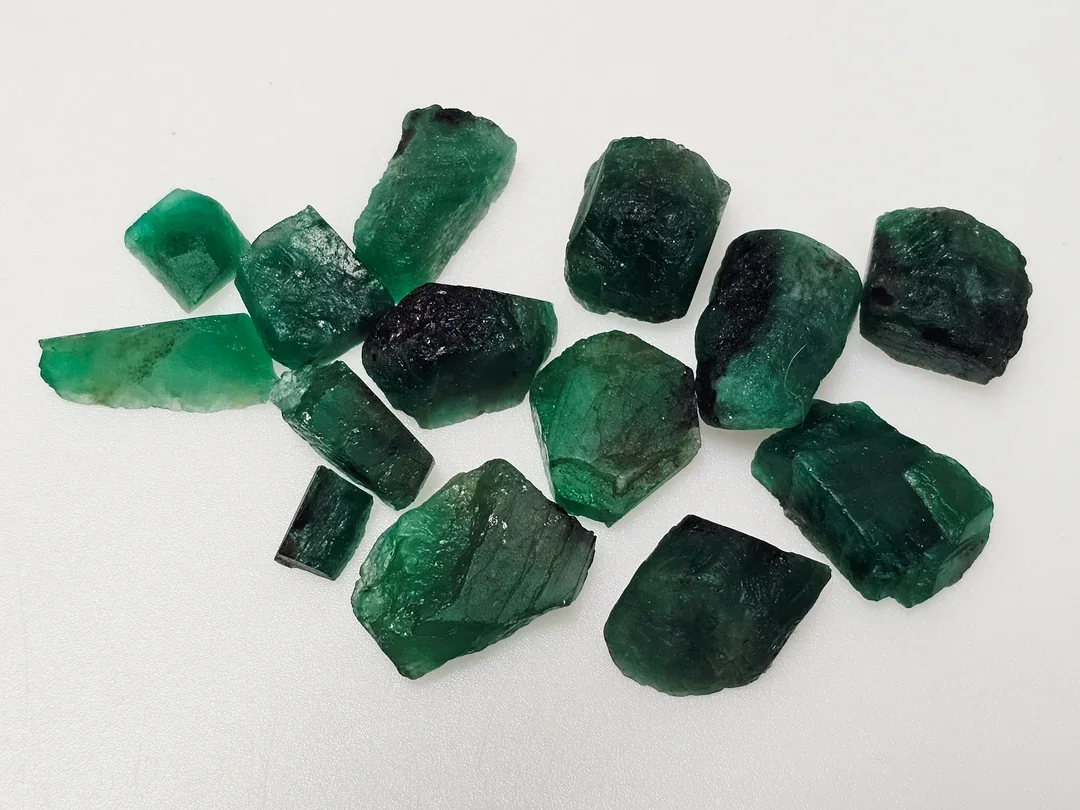
Zambian rough material
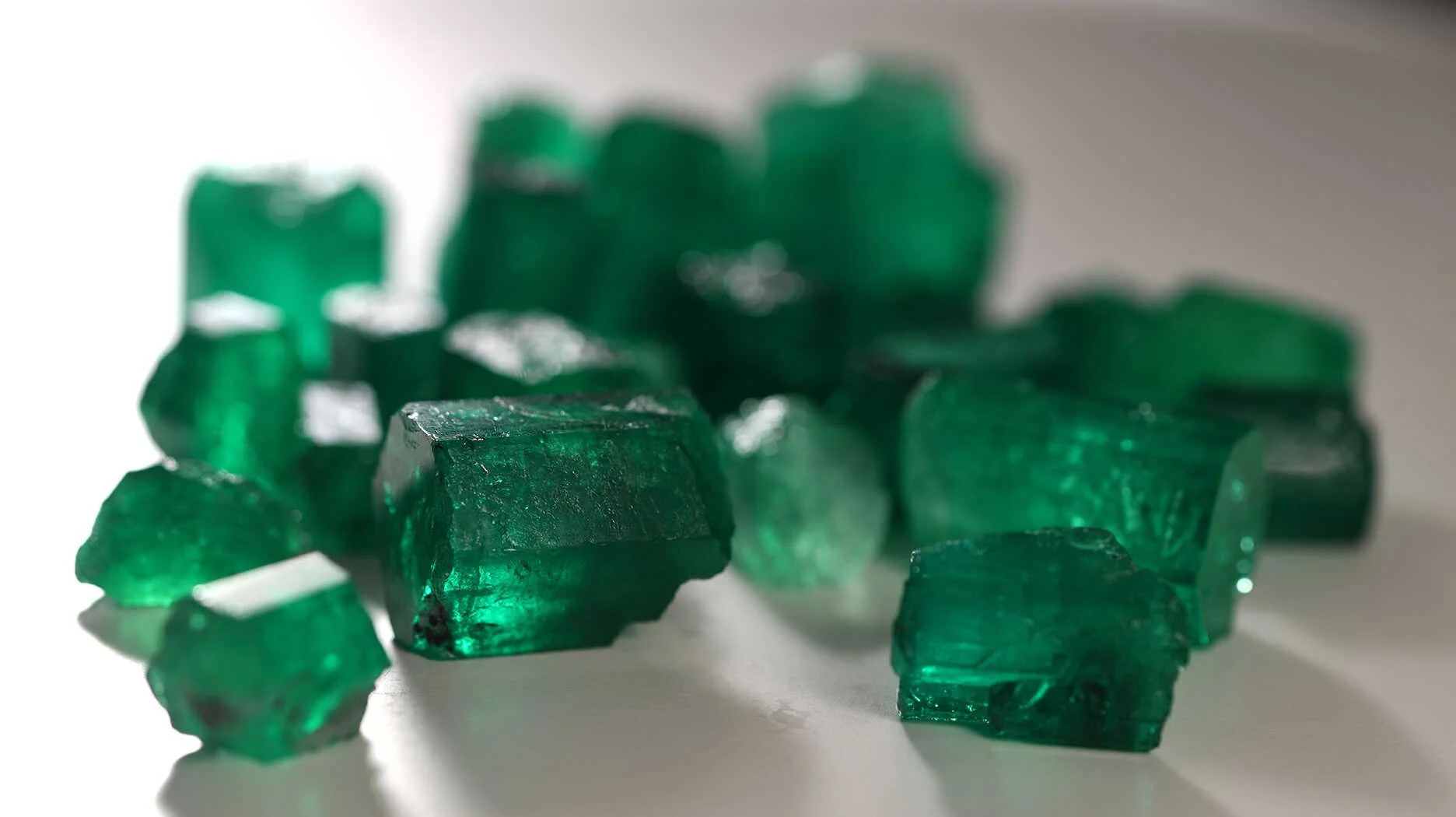
Colombian rough material
Where the Two Origins Sit in the Market
Colombia and Zambia are the world's two most commercially significant emerald sources. Colombian deposits principally Muzo, Chivor, and Coscuez have been mined continuously for over 500 years and carry the longest documented trade history of any coloured gemstone origin. Their stones appear in the collections of Mughal emperors, the Spanish Crown, and every major international auction in the modern era.
Zambian production, centred on the Kagem and Grizzly mines in the Kafubu River area of the Copperbelt region, scaled significantly from the 1970s onward. Kagem, now part of the Gemfields group, is one of the largest single emerald mines in the world by volume. Zambia now accounts for a substantial share of global emerald supply industry estimates place it as the world's second-largest emerald producer after Colombia.
Both origins produce stones across the full quality range. The differences between them matter because origin is a primary driver of value, certification language, and buyer preference at the fine end of the market.
Colour: The Most Visible Difference
The Chemistry Behind Colombian Colour
Colombian emeralds are coloured primarily by chromium (Cr), with vanadium (V) contributing in varying proportions depending on the specific mine. The single most important chemical distinction between Colombian and Zambian material is iron content. Published research in the GIA's peer-reviewed journal Gems & Gemology (Palke et al., 2019 "Geographic Origin Determination of Emerald") confirms that Colombian emeralds contain the lowest iron concentrations of any major commercial emerald source. This matters because iron introduces blue and grey interference tones that reduce both saturation and warmth. The near-absence of iron in Colombian material allows the chromium-driven green to dominate cleanly, producing the warm, slightly yellow-green hue the market calls "Colombian green" or "Muzo green."
The finest Colombian stones particularly from the Muzo deposit display a characteristic known as gota de aceite (Spanish for "drop of oil"): a turbid, opalescent quality within growth planes that gives the stone a particular velvety depth under magnification. The GIA's 2019 origin study notes that gota de aceite is far more common in Colombian emeralds than in stones from any other source. It is not present in Zambian material and is a useful supporting indicator of Colombian origin.
The Chemistry Behind Zambian Colour
Zambian emeralds formed in a metamorphic environment specifically in a reaction zone between granitic pegmatites and mafic or ultramafic schists. This geological setting introduces iron into the crystal lattice during formation, which shifts the hue toward blue and produces the characteristic cooler, blue-green tone that distinguishes Zambian material. The chromium content in Zambian stones is also significant, and fine Zambian stones can display exceptional saturation but the warmth of the hue is moderated by the iron component in a way that Colombian stones are not.
The Zambian blue-green is not a deficiency. It is a geological consequence that many buyers actively prefer. Several important jewellery houses and designers specify Zambian stones precisely because the cooler, deeper tone suits certain metal and design contexts particularly white gold and platinum settings where a Colombian stone's warmth would read differently.
DEALER INSIGHT
What the Colour Difference Actually Looks Like in Person
The colour difference between a fine Colombian and a fine Zambian emerald is real and visible without specialised equipment. It is not always dramatic at commercial grades, but at fine and extra-fine quality it is immediately apparent when both stones are held together in natural daylight.
A fine Muzo stone has a warmth to it that reads as almost luminous the green is clean and the absence of grey or blue interference is noticeable even to someone who has never evaluated an emerald before. A fine Zambian stone in the same light reads as crisper, cooler, and in some contexts more intensely saturated but the warmth is absent.
Neither is objectively superior. The Colombian warmth and the Zambian depth are both genuine expressions of colour quality. What we find in our showroom appointments is that buyers tend to prefer one or the other within about thirty seconds of seeing them together and that preference is consistent. Showing both stones side by side is always more useful than describing the difference in words.
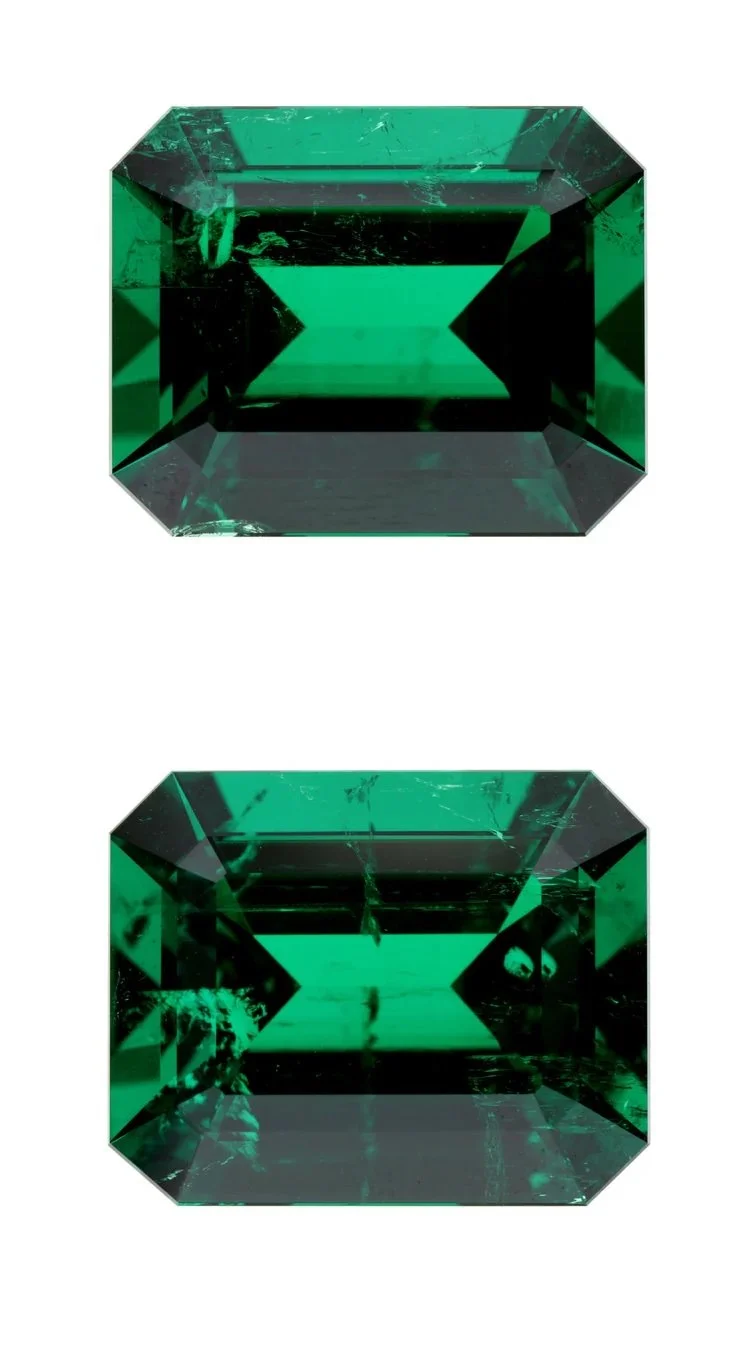
Muzo Emerald non oil. Source https://muzo.co/collections/sales-exclusives/products/agua-y-fuego
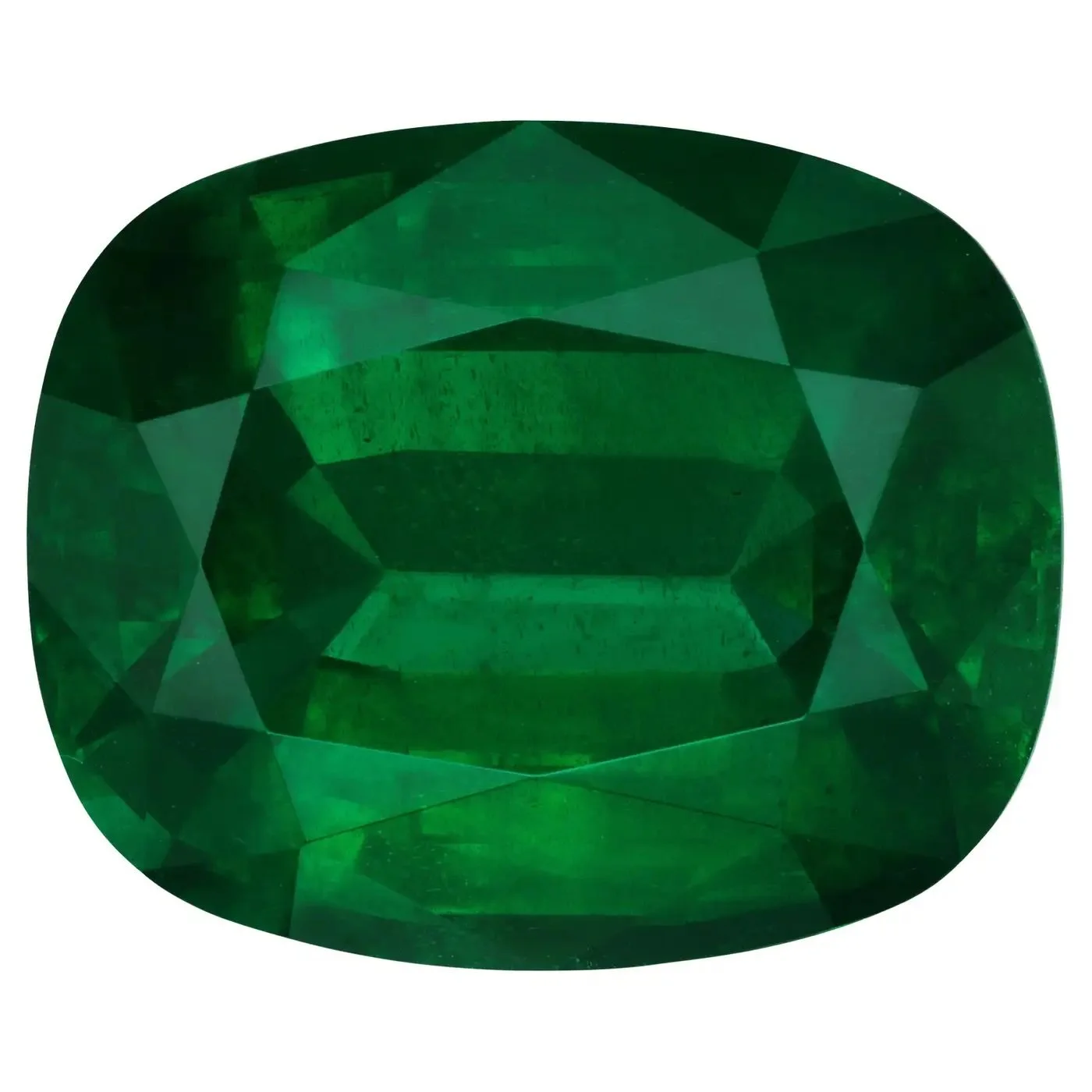
Clarity and Inclusions
What the Jardin Tells You About Origin
All natural emeralds contain inclusions. The French trade term jardin (garden) describes the internal landscape of fluid inclusions, crystals, and fractures that are accepted as characteristic of the species. Emeralds are classified by the GIA as Type III gemstones, meaning that inclusions are expected and that clarity grading must be applied with different standards than those used for diamonds.
The inclusion character of Colombian emeralds is geologically distinctive. The most diagnostic feature is the three-phase inclusion: a jagged, sawtooth-edged fluid cavity containing a gas bubble, a cubic halite or sylvite crystal, and a saline liquid phase. These are examined by gemological laboratories as supporting evidence in origin determination. Additionally, parisite a calcium cerium fluorocarbonate mineral is the only inclusion mineral ever documented exclusively in Colombian emeralds and has never been identified in stones from any other origin (Gübelin & Koivula, Photoatlas of Inclusions in Gemstones, Vol. 3, 2008). Its presence under magnification is a strong diagnostic indicator.
Zambian emeralds typically contain simpler inclusions: actinolite needles, biotite platelets, pyrite crystals, and two-phase fluid inclusions. The inclusion density at equivalent quality tiers is generally lower than in Colombian material, which is one reason Zambian stones often present with better apparent clarity per dollar at commercial and mid-tier grades. For laboratory origin determination, Zambian inclusions are assessed alongside chemical data no single inclusion type is individually conclusive for Zambian origin, just as none is conclusive for Colombian origin without the full suite of tests.
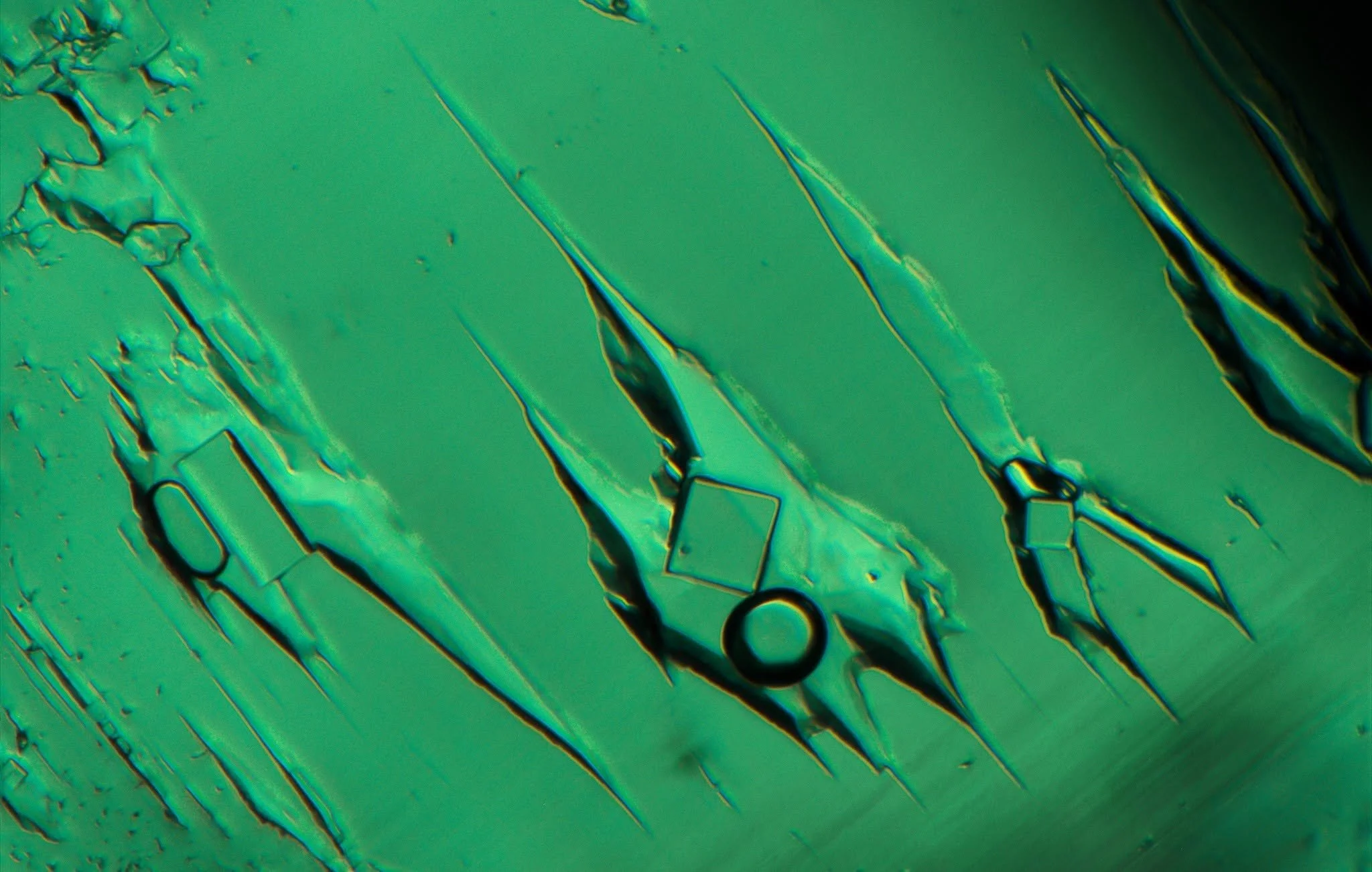
A three-phase jagged fluid inclusion in a Colombian emerald, photographed through our gemological microscope at 20x magnification. These inclusions are a key indicator examined by origin laboratories
Durability Considerations
A common claim in the market is that Zambian emeralds are more durable than Colombian stones due to their geological formation environment. This requires careful qualification. Emerald hardness (7.5–8 on the Mohs scale) does not vary by origin both Colombian and Zambian stones are the same species of beryl. The durability difference, where it exists, relates not to the mineral itself but to the prevalence of surface-reaching fractures. Stones with more extensive fracturing are more vulnerable to chipping and require more careful handling, particularly in ring settings worn daily. In this narrow sense, Zambian stones which on average have fewer surface-reaching fractures at commercial grades may present marginally lower fracture-related risk. But this is a generalisation across quality tiers, not a fixed rule for individual stones.
Treatment: Oil, Resin, and What the Labels Mean
Nearly all commercially available emeralds regardless of origin are treated with oil or resin to fill surface-reaching fractures. This reduces the visibility of fractures, improving the stone's apparent clarity. It is an accepted, centuries-old industry practice. The relevant question is not whether a stone has been treated, but to what degree and with what material.
Treatment Grading
The GIA describes clarity enhancement on its Colored Stone reports using the designations F1 (minor), F2 (moderate), and F3 (significant). Gübelin and SSEF use a descriptive scale. As of 1 November 2025, Gübelin discontinued the "insignificant" category from their emerald treatment reports. Stones previously described as "insignificant" enhancement are now classified as "No indications of clarity enhancement" a change aligned with the Laboratory Manual Harmonisation Committee (LMHC) standards that effectively reclassifies the most lightly treated stones upward. Buyers comparing older and newer Gübelin reports should be aware of this terminology shift.
Treatment Rates by Origin
In general trade experience, Colombian emeralds at lower clarity grades are more commonly treated and more heavily treated due to the higher prevalence of surface-reaching fractures that characterise Colombian rough. However, fine Colombian stones with no treatment or minor treatment exist and command the strongest market premiums. A no-oil Colombian emerald of fine colour above 2 carats is among the rarest combinations in the market.
Zambian emeralds on average require less treatment due to fewer surface fractures at comparable quality tiers. This is one reason Zambian stones can appear cleaner and more consistent in commercial jewellery production. However, treatment varies significantly by individual stone. A Zambian stone with significant resin treatment is not preferable to a Colombian stone with minor cedar oil treatment should always be assessed on the individual stone and documented by a laboratory report, regardless of origin.
DEALER INSIGHT
The Treatment Conversation We Have With Every Buyer
Treatment is the topic that generates the most confusion in our client consultations. Most buyers arrive having read that "treated" emeralds are inferior. The reality is more nuanced.
Cedar oil treatment the historic and most common enhancement is reversible, natural, and stable under normal wear conditions. What buyers need to know is this: do not put an oiled emerald in an ultrasonic cleaner. Ultrasonic cleaning dissolves cedar oil. If your jeweller uses an ultrasonic cleaner without asking whether your stone is emerald, that is a problem. A reputable jeweller will always ask. The treatment itself is not the issue it is knowing about it and caring for the stone accordingly.
Resin treatment (such as Opticon) is more stable but considered a greater intervention because it bonds permanently to the fracture walls and is not reversible. Stones with significant resin treatment are valued lower than equivalent stones with cedar oil treatment or no treatment at all.
When we sell a stone with any level of treatment, we disclose it in writing, with the laboratory documentation to confirm. If a seller cannot tell you the treatment type and degree, that is not a stone you should be purchasing.
Origin Certification
For stones above approximately 1 carat where origin affects value materially, laboratory certification of geographic origin is the accepted market standard. Origin determination requires a convergence of evidence: UV-Vis-NIR spectroscopy, trace element chemistry via LA-ICP-MS, and microscopic inclusion analysis. No single piece of evidence is individually conclusive. Origin attributions are stated as "consistent with" a particular geographic source, which reflects the probabilistic nature of the assessment even with the full suite of tests.
Which Labs for Which Origins
For Colombian emeralds, the primary reference laboratories are CDTEC ( Colombia), Gübelin Gem Lab (Switzerland) and SSEF Swiss Gemmological Institute widely regarded as the definitive authorities on Colombian origin determination and accepted universally at auction. GIA's Colored Stone Identification & Origin Report with geographic origin opinion is also widely accepted, particularly in the Australian and North American markets.
For Zambian emeralds, GIA, GRS (GemResearch Swisslab), and AGL (American Gemological Laboratories) all provide widely accepted origin reports in addition to Gübelin and SSEF. The choice of laboratory for Zambian stones is somewhat more flexible all five are accepted in reputable trade and auction contexts.
In both cases, a report should document: country of origin, colour description, clarity enhancement type and degree, carat weight, and millimetre dimensions. For investment-grade stones, a Gübelin or SSEF report is the market standard regardless of origin.
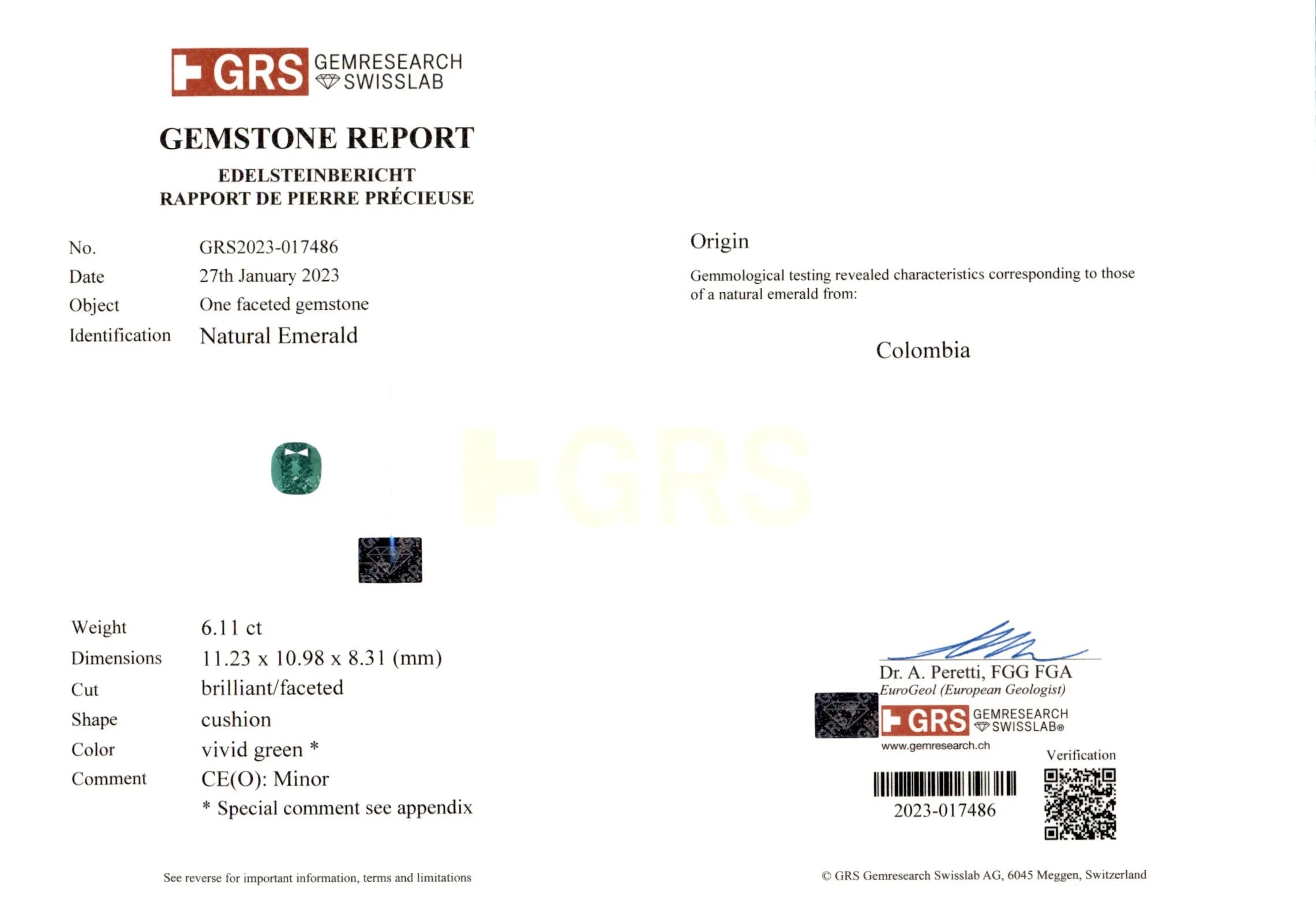
Photograph of an actual GRS origin report for a Colombian emerald (client details redacted), showing the origin determination section and treatment disclosure section clearly.
Price: How Origin Affects Value
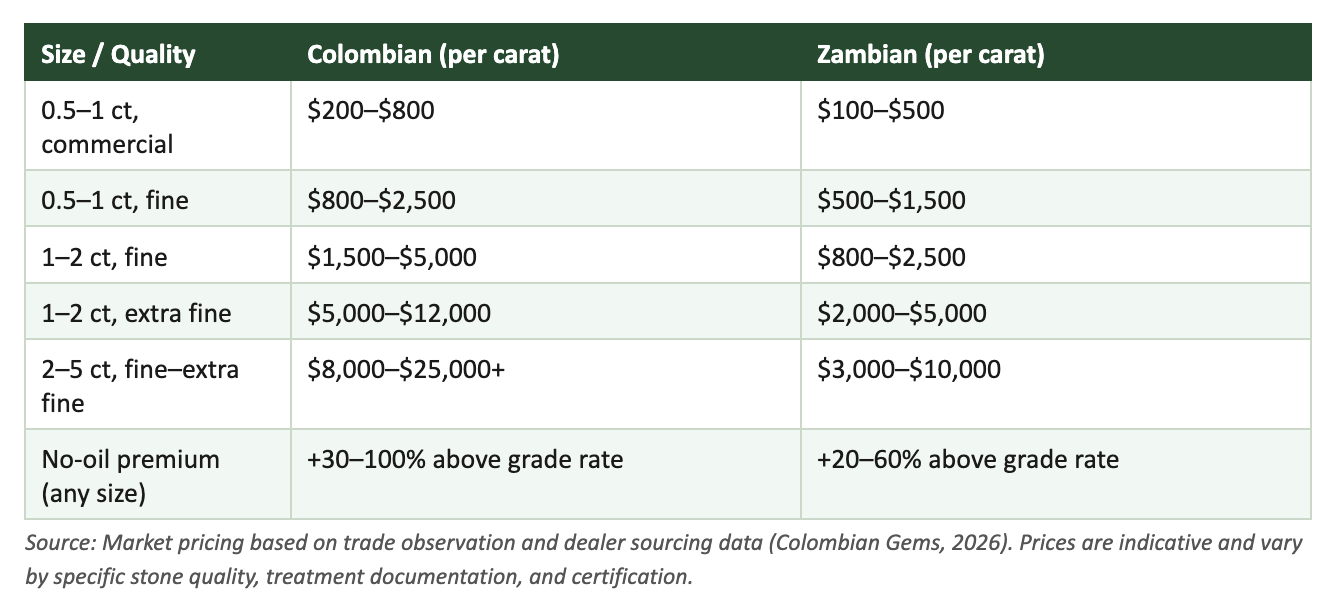
Pricing by Quality Tier and Origin
The table below reflects current market pricing observations for cut, polished, certified stones. These are indicative ranges based on trade data and direct sourcing experience individual stones will vary based on specific quality profile, treatment documentation, and laboratory certification. No-oil stones at any tier command a further premium above the ranges shown.
The Colombian Premium and Where It Comes From
Fine Colombian emeralds command a premium over comparable Zambian stones. This premium is not arbitrary. It reflects several converging factors: the chromium-driven colour warmth that the market has historically valued most; the documented demand from major auction houses (Christie's, Sotheby's, Bonhams) where Colombian origin with Gübelin or SSEF documentation is a prerequisite for significant lots; the limited supply of fine certified Colombian stones relative to global demand; and over five centuries of uninterrupted market presence.
At fine grades with strong documentation, industry participants typically observe a 20 to 50 percent premium for Colombian origin over equivalent Zambian material. At commercial grades, the gap is smaller and in some cases negligible particularly for jewellery production where origin is not disclosed at the retail level.
The Zambian Value Proposition
Zambian emeralds offer a genuine and commercially rational alternative for buyers who prioritise vivid saturation, cleaner clarity, and strong value per dollar without requiring Colombian provenance. For jewellers producing commercial to mid-tier pieces at volume, Zambian material is often more practical: consistent supply from large-scale mines, predictable clarity profile, and competitive pricing. For collectors who specifically prefer the cooler blue-green tone, fine Zambian stones represent outstanding quality.
It is worth noting that the Zambian market has matured significantly. Fine Zambian stones with exceptional colour and GRS or Gübelin documentation now trade at price points that were not achievable a decade ago. The origin still trades at a discount to Colombian at equivalent quality, but the gap at the finest grades has compressed as the market has come to understand and appreciate Zambian quality.
DEALER INSIGHT
Sourcing Both Origins: What We Actually See at the Wholesale Level
We source Colombian material through our Bogota office and evaluate Zambian stones through established wholesale channels. Comparing both at source has given us a practical view of the quality distribution in each origin.
At fine and extra-fine grades, the Colombian premium is real and well-supported by what we see in stones. Fine Colombian material with no-oil documentation is genuinely scarce in evaluating large parcels, the proportion of stones that qualify as fine colour with minor or no treatment is consistently small. When those stones appear, they are priced accordingly and move quickly.
Fine Zambian material is more consistently available at equivalent quality grades the mine operations are larger and more industrialised, which means cleaner, more predictable quality for commercial buyers. The trade-off is that the exceptional "presence" we associate with the finest Colombian stones that combination of warmth, transparency, and life is not replicated in Zambian material, however good the documentation.
For buyers working to a fixed budget, Zambian material often delivers more stone for the money. For buyers who want the finest available and have no fixed ceiling, Colombian with documentation is the correct choice.
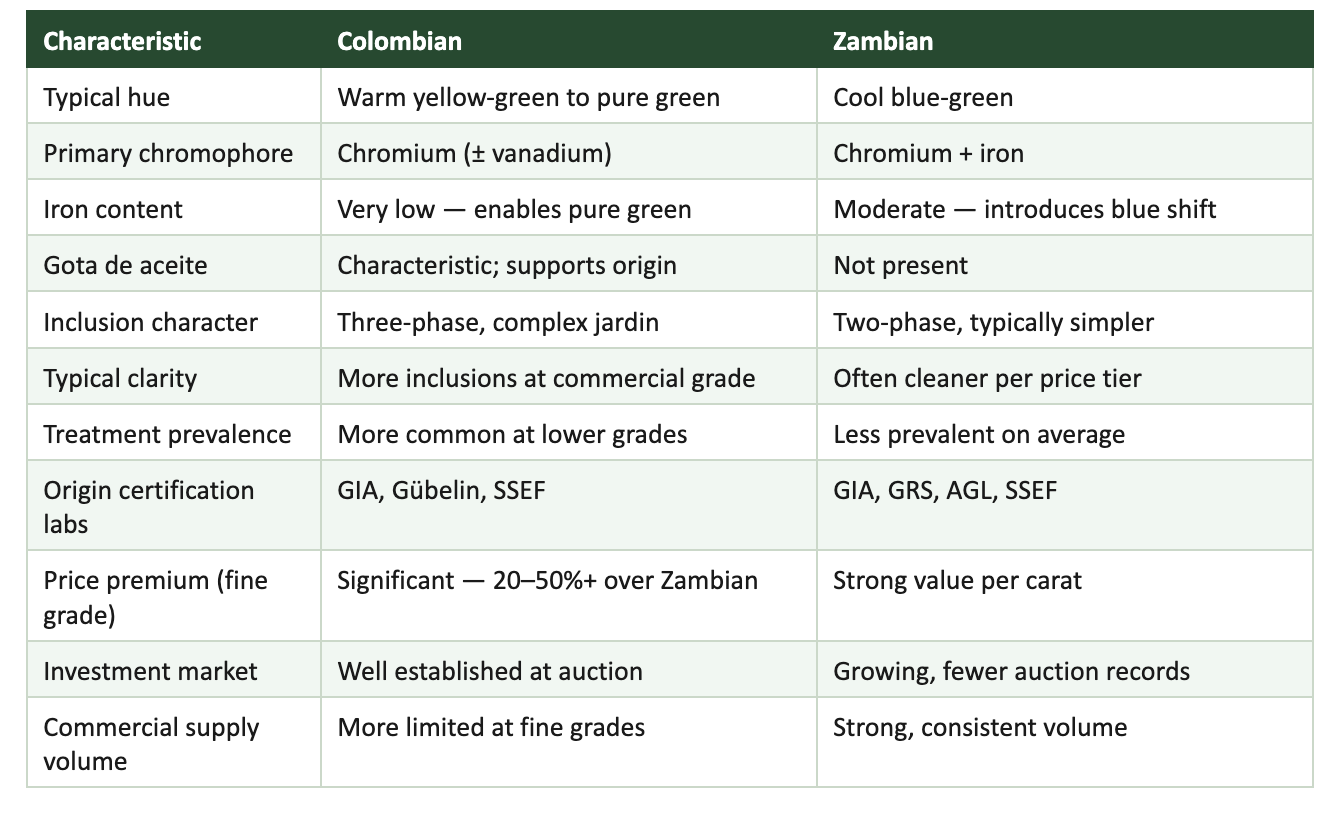
Side-by-Side Summary
Which Should You Buy?
Choose Colombian if: colour warmth and Colombian provenance are priorities; you are buying at fine or investment grade; the stone will be certified and potentially resold through dealers or auction; or you specifically want the warmth and depth associated with chromium-dominant Colombian material.
Choose Zambian if: you prefer a cool, vivid blue-green; clarity per dollar is the priority; you are buying for jewellery production at volume; or you want a fine stone with strong saturation without paying the Colombian origin premium.
The distinction matters most at fine grades. In commercial and mid-tier jewellery, the practical difference is smaller, and personal taste should drive the decision. Neither origin is objectively superior — they are genuinely different, and understanding that difference is what allows buyers to make an informed choice.
We work directly with Colombian supply through our Bogota sourcing office and can arrange in-person viewings of certified Colombian emeralds at our Sydney showroom. If you are a jeweller or buyer comparing origins for a specific brief, contact us to discuss your requirements.
Contact us to arrange a viewing appointment
Frequently Asked Questions
Are Colombian emeralds always better than Zambian emeralds?
No. Colombian emeralds are preferred in fine jewellery and investment markets due to their chromium-driven colour warmth and provenance premium. Zambian emeralds offer strong saturation and often better clarity at equivalent price points. The better choice depends on the buyer's colour preference, intended use, and budget.
What makes Colombian emeralds more expensive than Zambian?
The Colombian premium reflects chromium-driven colour warmth (made possible by exceptionally low iron content), five centuries of documented market reputation, limited supply of fine certified stones, and established demand from international auction houses. A certified Colombian stone with no or minor treatment commands the highest premiums.
Do Zambian emeralds need less treatment than Colombian emeralds?
On average, yes — Zambian emeralds tend to have fewer surface-reaching fractures and may require less fracture-filling treatment. However, treatment varies by individual stone. Always request a laboratory report assessing clarity enhancement regardless of origin.
How can I verify whether an emerald is Colombian or Zambian?
Geographic origin is determined by accredited laboratories including GIA, Gübelin, SSEF, GRS, and AGL, using UV-Vis-NIR spectroscopy, LA-ICP-MS trace element chemistry, and inclusion analysis. For stones above 1 carat, a current laboratory report is the accepted market standard.
What is gota de aceite and does it only appear in Colombian emeralds?
Gota de aceite (Spanish for "drop of oil") is a growth feature a turbid, opalescent quality in growth planes that is overwhelmingly characteristic of Colombian emeralds. The GIA's peer-reviewed research identifies it as far more common in Colombian material than any other source. It is not present in Zambian emeralds.
Can I view Colombian emeralds in Sydney before purchasing?
Yes. Colombian Gems operates a Sydney showroom where buyers can view certified loose Colombian emeralds in person under multiple lighting conditions. Contact us to arrange a private viewing appointment.