

Understanding Emerald Treatments: How GIA Grades Clarity Enhancement
Mateo Patino, Founder, Colombian Gems
If you are sourcing or buying a Colombian emerald, the treatment observation on the laboratory report is one of the most important details to understand.
GIA's clarity enhancement grading - reported as None, Minor (F1), Moderate (F2), or Significant (F3) - directly affects how a stone is valued, how it should be cared for, and what needs to be disclosed to buyers. Treatment grade is not a secondary consideration. It belongs at the centre of any emerald evaluation.
This article explains what each GIA treatment grade means in practice, how filler type factors in, and how to use this information when assessing or sourcing a stone.

Why Emeralds Are Commonly Treated
Emeralds grow under conditions that produce a high density of internal characteristics - fractures, growth channels, mineral inclusions, and fluid-filled cavities. Gemologists use the French term jardin (meaning garden) to describe this internal landscape. Jardin is a characteristic feature of many natural emeralds, not unusual for the species.
Because of this, many emeralds - including high-quality stones - undergo clarity enhancement after cutting. The most common method is filling surface-reaching fractures with oil or resin to reduce their visibility.
Important context: Clarity enhancement is commonly encountered in the emerald trade and is generally accepted when properly disclosed. The issue is not treatment itself - it is whether the grade is accurately communicated at point of sale.
The GIA Emerald Treatment Grading System
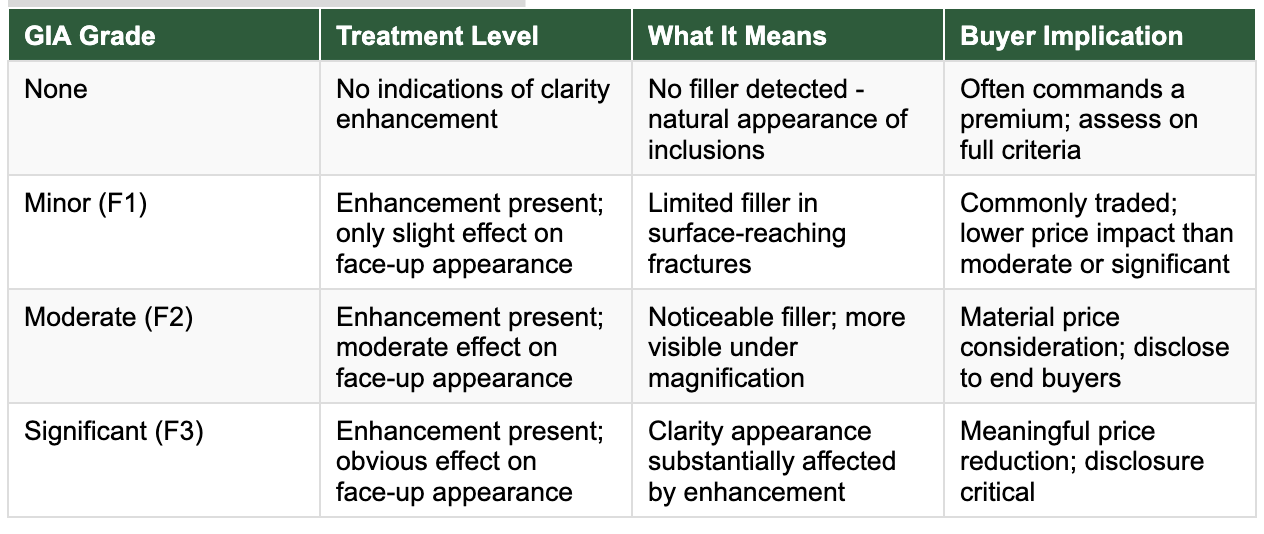
GIA assesses emerald clarity enhancement and reports the result using standardised wording. Where no enhancement is detected, the report states this. Where enhancement is present, it is classified as Minor (F1), Moderate (F2), or Significant (F3), reflecting the degree of its effect on the stone's face-up appearance.
GIA Treatment Grades at a Glance
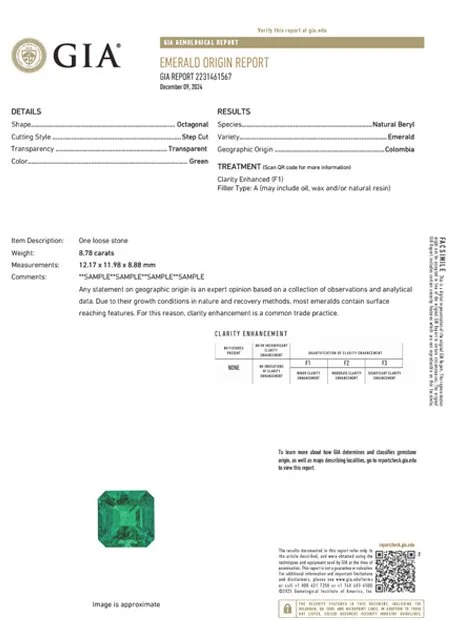
GIA laboratory reports include a treatment-related observation alongside other gemological assessments. The wording is standardised. Read the full observation text - not just the grade label - as it provides the most precise characterisation.
Note: GIA now also offers optional filler identification on emerald reports. Where filler material can be characterised, the report may indicate the filler type (commonly noted as Type A or Type B). This identification is not always possible and is offered as an additional service rather than a standard report element.
None - No Indications of Clarity Enhancement
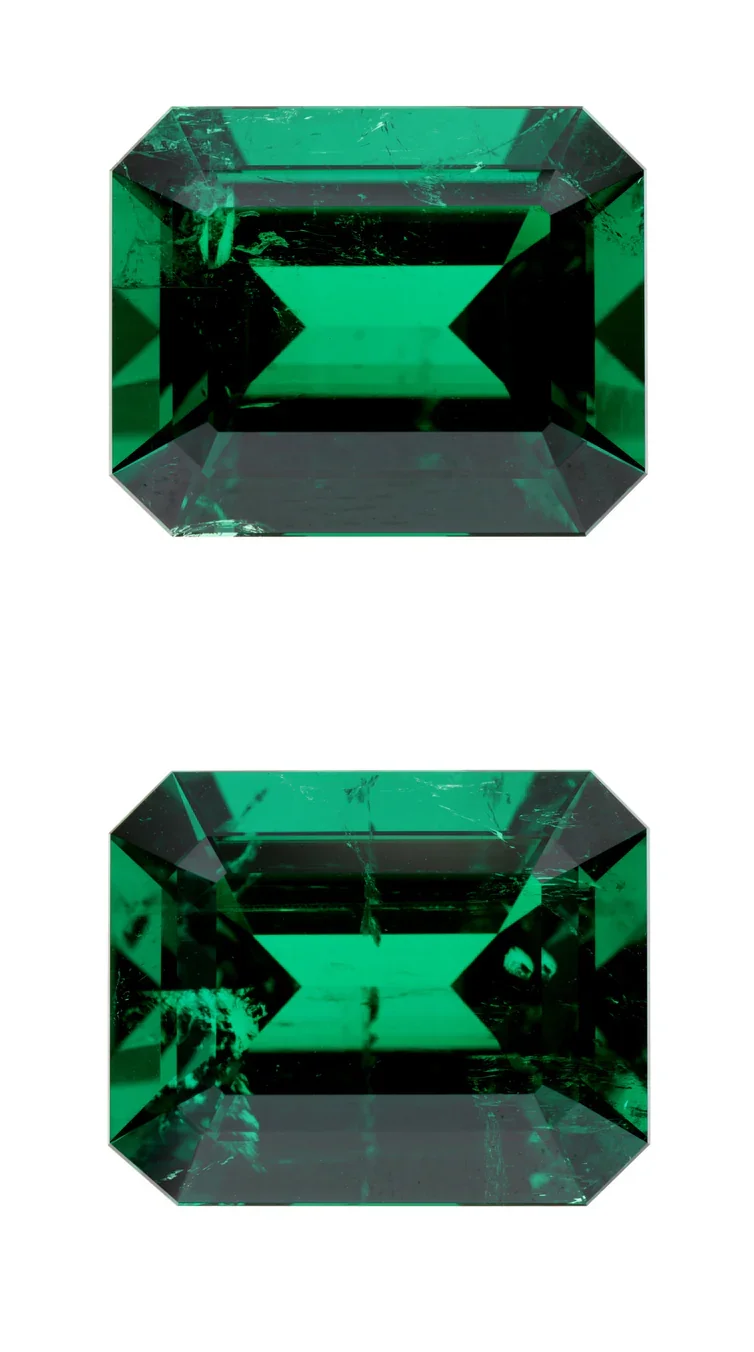
When a GIA report states no indications of clarity enhancement, the laboratory found no detectable filler material in the stone's fractures or surface features.
Untreated stones of fine colour and clarity are generally regarded as uncommon, particularly at significant carat weights. Where they exist, they tend to command a premium over comparable treated stones - the extent of which varies considerably depending on colour, clarity, origin, and prevailing market conditions.
What 'None' Means in Practice
No detected treatment does not mean the stone has no internal characteristics. Colombian emeralds graded with no indications of clarity enhancement can still exhibit jardin. The distinction is that no material has been used to fill or mask those features.
Untreated stones do not carry filler-maintenance concerns, which some buyers - particularly collectors focused on long-term preservation - find relevant to their purchasing decision.
Internal link: See our guide to Colombian emerald certification and what to look for on a laboratory report. [Link to: /emerald-certification or equivalent page - verify slug before publishing]
Minor (F1) - Limited Enhancement, Slight Visual Effect
Minor, or F1, means GIA detected limited filler material in surface-reaching fractures, and that the enhancement has only a slight effect on the stone's face-up appearance.
Minor-treated stones are commonly transacted in the emerald trade. The treatment grade is factored into pricing alongside other variables - colour, clarity, carat weight, origin documentation, and market conditions. It is not generally regarded as a barrier to quality material, provided it is properly disclosed.
Filler Type: Cedar Oil and Resin
Where filler type is identified, cedar oil and synthetic resins are the materials most commonly encountered. Cedar oil has long been used as a treatment medium; its optical properties help reduce the visibility of fractures. Some synthetic resins are generally more persistent than oils and may present different retreatment considerations.
GIA's standard report may not specify filler type unless optional filler identification is requested and the material can be characterised. Some non-GIA laboratory reports, including those from Gübelin and GRS, may include additional filler characterisation detail where relevant to the transaction.
For jewellers: Avoid ultrasonic cleaners and steam on treated emeralds, as filler material can be affected by heat and chemicals. Brief your setter on the treatment grade before any work begins.
Moderate (F2) - Noticeable Enhancement, Material Price Consideration
A moderate, or F2, GIA grade means the clarity enhancement has a moderate effect on the stone's face-up appearance. Under magnification, filled fractures may be observable in these stones.
Moderate treatment tends to affect price relative to minor-treated stones of otherwise comparable quality. The degree of this difference depends on the stone's other characteristics and the specific transaction. Buyers should disclose the treatment grade to any end purchaser.
Care and Setting Considerations for Moderate Treatment
More heavily filled stones may be more sensitive to heat, chemicals, and ultrasonic cleaning. Jewellers setting or repairing these stones should work accordingly and advise clients about appropriate care. Retreatment may be worth considering following repair work that involves heat exposure, depending on the stone and filler type.
Internal link: For sourcing guidance on treatment grades and what to specify when ordering Colombian material, contact our Sydney team or browse verified loose stones. [Link to: /contact or /loose-colombian-emeralds - verify slug before publishing]
Significant (F3) - Obvious Enhancement, Disclosure Critical
A significant, or F3, GIA grade means the clarity enhancement has an obvious effect on the stone's face-up appearance. The apparent clarity of the stone is substantially affected by the treatment.
Significant-grade stones are commercially traded, typically at a greater discount relative to minor-treated equivalents than moderate-grade stones. Accurate disclosure is essential - ethically and, depending on jurisdiction, legally. The Australian Competition and Consumer Commission (ACCC) has published guidance on fair-trading in the jewellery industry that emphasises truthful description and disclosure of treatments where they affect value.
When Significant Treatment Makes Sense
Not every buyer requires an untreated stone. A significant-grade Colombian emerald with strong colour may represent reasonable value as a centre stone for certain jewellery applications, provided:
The treatment grade is clearly disclosed at point of sale
The buyer understands the care implications
The stone is priced in line with its market position
The jeweller or setter is briefed on the stone's characteristics
Where significant-grade stones present risk is when they are sold without disclosure, or priced against untreated or minor-treated comparables. This is where treatment misrepresentation can occur.
Which Laboratory Reports Cover Emerald Treatments
Major gem labs commonly comment on emerald treatment, though terminology and depth of analysis vary:
CDTEC - (Centro de Desarrollo Tecnológico de las Esmeraldas de Colombia) is a Colombian gemological laboratory specialising in emerald analysis. Based in Bogotá, it offers origin determination and treatment assessment for Colombian emeralds, with particular relevance to the local trade and mining sector.
GIA - issues emerald laboratory reports with treatment-related observations using the None/Minor (F1)/Moderate (F2)/Significant (F3) classification. Now offers optional filler identification as an additional service. Commonly requested across commercial markets.
Gübelin - Swiss laboratory known for detailed origin and treatment analysis. Reports may include additional filler characterisation. Often preferred for significant stones and estate transactions.
GRS (Gem Research Swisslab) - provides origin determination alongside treatment grading. A commonly requested report in parts of the Colombian and Asian trade.
SSEF - Swiss Foundation for the Research of Gemstones. Provides detailed treatment analysis; reports are used in high-value commercial contexts.
For Colombian emeralds intended for resale, high-value bespoke work, or investment, obtaining a current laboratory report from one of the above laboratories is strongly advisable. Without one, pricing and disclosure are difficult to substantiate.
Internal link: Read our overview of emerald certification laboratories and which report to consider for different buyer types. [Link to: /blog/emerald-certification-guide - verify slug before publishing]
How Treatment Grade Affects Price
There is no fixed multiplier for treatment grade. Pricing is influenced by colour, clarity, carat weight, origin documentation, and market conditions. Treatment grade is one variable in that picture.
The directional relationship is broadly consistent: stones with no detected treatment often command a premium over treated equivalents, all else equal. Minor-treated stones generally price higher than moderate, and moderate higher than significant. The extent of each difference depends on the specific stone and transaction.
Origin can also influence how stones are perceived in different market segments. Where Colombian provenance is documented, some buyers place additional weight on it - though the degree to which this affects price varies by buyer type and market context.
Practical Guidance for Jewellers and Trade Buyers
If you are sourcing Colombian emeralds for client work:
Request a current laboratory report - not a copy or photograph of a previous one
Read the full treatment observation, not just the grade label
Factor treatment grade into your pricing model before quoting a client
Disclose treatment grade in writing at point of sale
Brief your setter on cleaning and setting restrictions based on the treatment grade
For high-value pieces, consider whether a Gübelin or GRS report would provide additional detail relevant to your client's needs
For collectors and private buyers: treatment grade is information that should be available upfront from a seller working with current laboratory documentation. If a seller is reluctant to provide an up-to-date laboratory report, treat that as a due diligence consideration.
A Note on Older Laboratory Reports
Laboratory reports may remain valid documents, but their treatment observations can become outdated. A stone that has been cleaned, reset, or retreated since its last report may no longer accurately reflect its current treatment status.
For stones changing hands at significant value, a fresh report from the original laboratory is worth considering. GIA, Gübelin, and GRS each offer re-examination services for previously assessed stones, subject to their respective procedures.
Sourcing Note
Colombian Gems works with direct sourcing relationships in Muzo, Chivor, and Coscuez. We are able to assist jewellers and trade buyers with certified Colombian emerald supply and can walk through laboratory report detail before purchase. For sourcing enquiries, contact our Sydney team directly.
FAQ
What does GIA mean when it says an emerald has 'minor' treatment?
Minor, or F1, means GIA detected limited filler material in the emerald's surface-reaching fractures, and that the enhancement has only a slight effect on the stone's face-up appearance. Minor-treated stones are commonly encountered in the emerald trade and are generally accepted when properly disclosed.
Is a treated emerald worth less than an untreated one?
In most cases, yes - stones with no detected treatment often command a premium over treated equivalents, all else equal. The degree varies depending on colour, clarity, carat weight, origin, and market conditions. Treatment grade (None, Minor/F1, Moderate/F2, Significant/F3) and the extent of its visual effect are key variables in that assessment.
Can emerald treatments be removed or reversed?
Some oil treatments can be reduced or renewed through professional handling, depending on the filler and the stone's condition. Synthetic resin fillers are generally more persistent and harder to address without specialist intervention. GIA's standard report may not specify filler type unless optional filler identification is requested and successful. Some non-GIA reports may include filler characterisation where available.
Do I need to tell a jeweller what treatment grade my emerald has?
Yes. Your jeweller or setter needs the treatment grade to use appropriate techniques. Ultrasonic cleaners and steam should be avoided for treated emeralds. Heat during setting or repair can also affect filler material. Providing the laboratory report to your jeweller before any work begins is advisable.
Which laboratories grade emerald treatments, and which should I request?
GIA, Gübelin, GRS, and SSEF all assess emerald clarity enhancement. GIA reports are commonly used across commercial transactions. For high-value stones, auction pieces, or where detailed origin and filler information is relevant to the buyer, reports from Gübelin or GRS may provide additional commentary that some buyers find useful.