

How to Buy a Colombian Emerald Online Safely From Anywhere in the World
Colombian Gems | Sydney, Australia | June 2026
Buying a Colombian emerald online is entirely reasonable — provided you know what to verify before transferring funds. The online market for Colombian emeralds ranges from established dealers with traceable sourcing to resellers offering unverified stones with no documentation. The risks are not theoretical. Unverified origin claims, undisclosed treatment, and misrepresented colour grades are routine problems in the online emerald trade.
This guide explains how to buy a Colombian emerald online without relying on trust alone: what documentation to require, how to use video review, how to interpret laboratory reports, and what separates a credible source from a risky one.
DEALER INSIGHT
Why This Guide Exists
At Colombian Gems, a meaningful share of the clients who contact us have already made one online emerald purchase they regret. The pattern is consistent: the stone arrived with no independent certificate, the colour looked nothing like the listing photograph, and treatment status was never disclosed.
In most cases, the seller was not fraudulent in a criminal sense — they were simply operating in a market that has no enforced disclosure standards. This guide is our attempt to change what buyers know before they buy, not after.
Why Buying Colombian Emeralds Online Requires More Due Diligence Than Most Gemstones
Emeralds are not like diamonds. The diamond trade has standardised GIA grading reports with consistent colour and clarity scales that translate reliably across dealers. The coloured stone market — and emeralds specifically — does not work this way.
Several factors make online emerald purchasing genuinely complex:
Origin is commercially significant and difficult to verify visually. Colombian emeralds carry a meaningful price premium over stones from Zambia, Brazil, or Ethiopia. Without a laboratory origin determination, there is no way to confirm Colombian provenance from a photograph. A stone described as "Colombian" without a certificate from an independent laboratory is an unverified claim, not a fact.
Treatment disclosure varies widely. The vast majority of Colombian emeralds undergo some level of oil or resin filling to reduce the visibility of surface-reaching fractures. This is accepted industry practice and does not disqualify a stone — but the extent of treatment affects value considerably. According to the Gübelin Gem Lab's updated 2025 treatment terminology framework, treatment descriptions should specify both the substance used and the degree of filling. A dealer who does not proactively disclose treatment status is either uninformed or choosing not to inform you.
Colour grading for emeralds is not standardised. Terms like "vivid green", "medium dark", and "Muzo green" mean different things to different sellers. Photographs rarely represent colour accurately across different screens and lighting conditions. The International Colored Gemstone Association (ICA) acknowledges the absence of a universal coloured stone grading standard — colour must be assessed on video, ideally under consistent lighting conditions.
None of this makes online purchasing impossible. It means the process requires specific verification steps that would not apply to, say, buying a diamond solitaire online.
The Online Emerald Buying Checklist
1. Require an Independent Laboratory Certificate
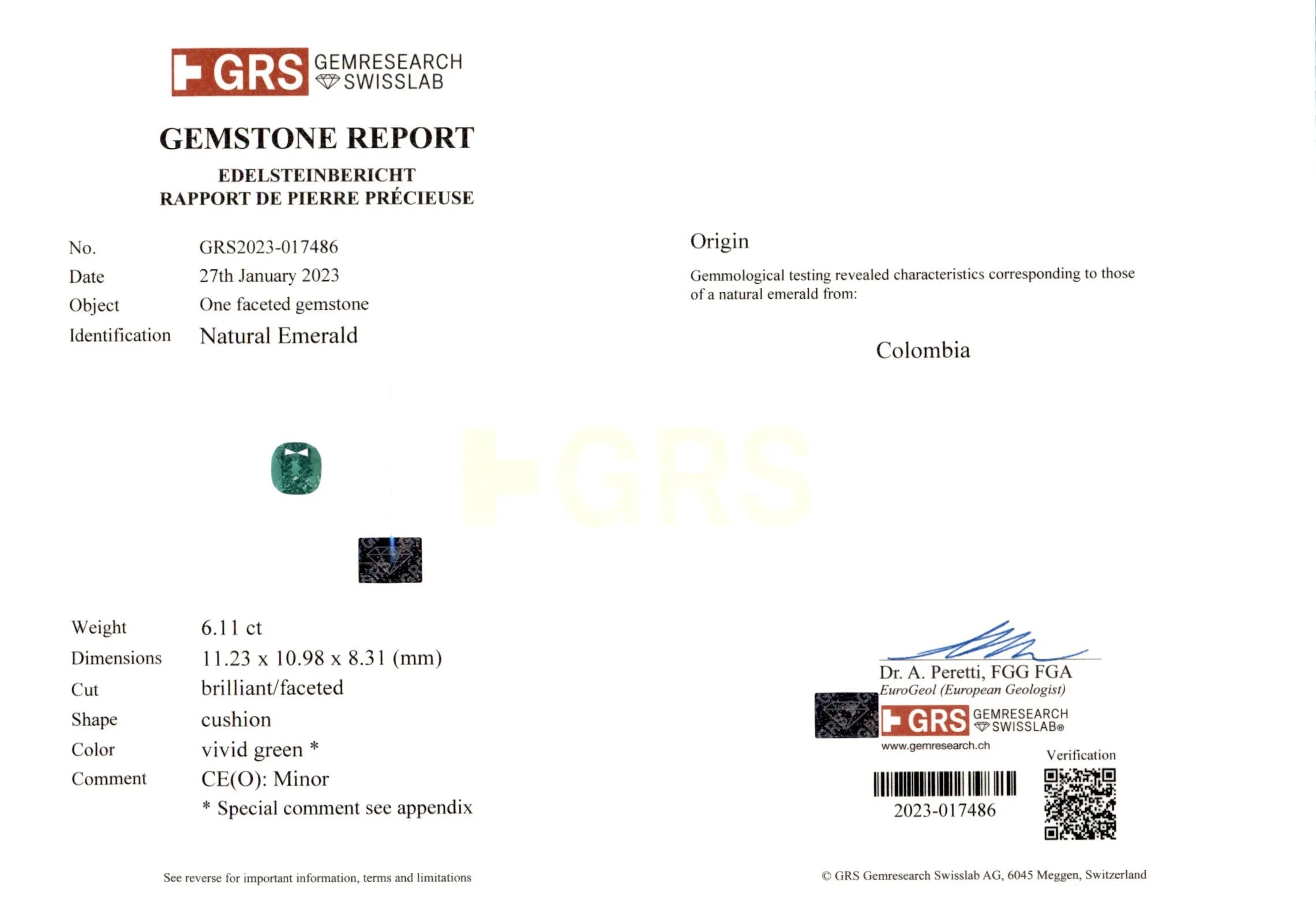
The first and most important requirement is a certificate from a recognised independent gemological laboratory. For Colombian emeralds, the accepted laboratories are:
CDTEC ( Colombian Emerald Technological Development Center ) Established in 2004, CDTEC is a specialized, non-profit gemological laboratory in Colombia, supported by the Ministry of Mines and Energy and major national emerald sector associations.
GIA (Gemological Institute of America) — widely recognised; issues coloured stone grading reports with origin determination, clarity characteristics, and treatment disclosure using the F1/F2/F3 classification system
Gübelin Gem Lab — Swiss laboratory with deep expertise in emerald origin determination; their reports carry significant weight at the highest trade levels and include updated 2025 treatment terminology
GRS (GemResearch Swisslab) — issues origin reports with quality grade nomenclature
SSEF (Swiss Gemmological Institute) — respected Swiss authority for provenance work on Colombian material
A certificate from one of these laboratories confirms: country of origin, treatment type and extent, and colour and clarity characteristics as assessed by trained gemmologists using equipment not available to the buyer.
Seller-issued certificates, unbranded "gemmological reports", or certificates from unknown laboratories do not carry independent verification. They are marketing documents, not independent assessments. If a listing offers only a "seller's certificate" or "in-house appraisal," request a recognised laboratory report or move on.
2. Understand Treatment Disclosure Before You Buy
Every reputable dealer will disclose treatment status upfront — before you ask. If you need to chase this information, that itself is relevant data about how the seller operates.
For Colombian emeralds, treatment is described in terms of oil or resin filling. GIA uses the nomenclature None, Minor, Moderate, and Significant to describe the extent of clarity enhancement. Gübelin and GRS use comparable language under their updated 2025 frameworks.
The treatment grade affects value materially. According to GIA's coloured stone grading research (Palke et al., 2019), treatment disclosure is a foundational component of accurate emerald valuation — the same carat weight and colour grade can carry meaningfully different price points depending on treatment level. Fewer than 5% of Colombian commercial-to-fine stones qualify as no-oil (none) under standard laboratory assessment.
Online listings that omit treatment status, describe stones as "natural" without clarifying whether this refers to origin or treatment, or characterise filling as irrelevant should be treated with caution.
DEALER INSIGHT
The Treatment Disclosure Conversation
We disclose treatment status in the first line of every listing. Not buried in the description — the first line. In our experience, a seller who makes treatment status hard to find is either not testing their stones independently or hoping the buyer does not ask. Both are problems for the buyer.
When you are evaluating a seller online, look for treatment information before you look at price. The sequence matters: stone quality, then treatment, then price — in that order.
3. Request a Video Review — Not Just Photographs
Photographs of emeralds are almost always taken under controlled lighting conditions designed to maximise colour saturation and minimise the appearance of inclusions. They are not reliable guides to what a stone will look like in normal wear conditions.
Before purchasing any emerald above a threshold you consider meaningful, request a video review. A proper video review should show:
The stone rotating under consistent daylight or daylight-equivalent lighting
The stone face-up, table-down, and at multiple angles
Visible inclusions or surface features — not hidden by lighting or camera angle
Colour under different light sources where possible (daylight versus incandescent)
A dealer who is not willing to provide a video review of a specific stone before purchase is not a dealer you should be buying from online. Video is the minimum standard of due diligence for any significant coloured stone purchase conducted remotely.
Verify the Source, Not Just the Stone
The certificate tells you about the stone. It does not tell you whether the dealer is a reliable counterparty.
For online emerald shopping, the source matters as much as the documentation. Questions worth asking before committing to any purchase:
Does the dealer have a verifiable physical presence — an office, a showroom, or a registered business address?
Can you find independent reviews, press coverage, or trade references beyond their own website?
Is the dealer transparent about their supply chain — where they source, which mining regions they work with, and whether they have direct relationships in Colombia?
Do they publish information about their certification partners and sourcing standards?
At Colombian Gems, our supply relationships run directly through mining families in Muzo, Chivor, and Coscuez, with a Bogota sourcing office and a Sydney showroom where stones can be viewed in person. Our sourcing by request service is available internationally for buyers who cannot travel to Sydney.
colombiangems.com.au/sourcing-by-request
Submit a stone brief and we will locate material matching your specifications from our Bogota office
5. Understand the Payment and Return Framework
For any online emerald purchase of significance, payment and return terms should be clear before you commit. Specific things to confirm:
Is there a return window, and what are the conditions?
Does the seller use a payment method that provides buyer recourse?
Is the stone insured during shipping, and to what declared value?
What documentation accompanies the shipment — is the original laboratory certificate included in the physical package?
Wire transfers without recourse, irreversible payment platforms, and no-return policies from unknown sellers are meaningful risk signals in the online emerald market. A credible dealer stands behind what they sell.
6. Understand Shipping and Insurance
For international purchases, customs implications vary by destination country. In Australia, imported gemstones are generally subject to GST on the declared value. Ensure the declared customs value matches the purchase price to avoid complications on arrival.
A credible seller ships with full insurance to the declared purchase value, uses tamper-evident packaging, and provides tracking from dispatch. For higher-value stones, specialist gem couriers are preferable to standard postal services
What the Price Range Tells You
In the online emerald market, price is one of the most useful diagnostic signals. Colombian emeralds of genuine quality are not cheap. Fine-quality Colombian material with independent origin certification from a recognised laboratory, treatment of none to minor, strong colour, and good clarity commands prices that reflect those attributes.
If a stone described as a "certified Colombian emerald" with strong colour and minimal treatment is priced at a level that seems low relative to comparable material you have researched, there is a reason. Common explanations include: undisclosed treatment, misrepresented colour, questionable origin claims, or a certificate from a non-independent source.
This does not mean every affordable stone is suspect. Lower-quality Colombian material, smaller stones, or stones with more significant treatment levels can be priced accessibly and still be genuinely Colombian in origin. The issue arises when descriptions do not match the price point — when a stone is described as exceptional but priced as average.
DEALER INSIGHT
What "Too Cheap" Actually Means
We are sometimes asked whether a stone a client found elsewhere is a good deal. In the majority of cases where the price seems surprisingly low for the described quality, one of three things is true: the origin has not been independently verified, the treatment level has not been disclosed, or the colour description is optimistic relative to what the stone will look like in normal light.
The online emerald market is competitive enough that genuine quality at a given price point is not hard to find — but it is not possible at every price point. If the deal looks exceptional, ask why before buying.
Red Flags in Online Emerald Shopping
Across the online emerald market, certain patterns recur in problematic transactions:
No independent laboratory certificate, or a certificate from an unfamiliar laboratory
Treatment status described as "natural" without clarifying whether oil or resin filling has occurred
Reluctance to provide a video review of the specific stone before purchase
Origin described as Colombian without any laboratory confirmation
No verifiable business address or physical presence
Pressure to complete transactions quickly
Payment methods that provide no buyer recourse
None of these individually guarantees a problem. Multiple together, and you are in a high-risk transaction.
Buying from Outside Australia
Our online showroom is available to buyers internationally. For buyers outside Australia, the process works as follows:
Browse our online inventory or submit a sourcing brief
Request a video review of shortlisted stones
Confirm the certificate, treatment disclosure, and pricing in writing
Arrange payment and confirm shipping destination and insurance terms
Receive the stone with the original laboratory certificate included
For buyers who want a stone not currently in our online inventory, our sourcing by request service works directly with our Bogota office to locate stones matching specific briefs — origin region, colour, carat weight, and treatment preference.
Frequently Asked Questions
Is it safe to buy a Colombian emerald online?
Yes, provided you require an independent laboratory certificate from GIA, Gübelin, GRS, or SSEF confirming Colombian origin and treatment disclosure, request a video review of the specific stone before purchasing, and buy from a dealer with a verifiable physical presence and transparent sourcing. Without these steps, online emerald purchasing carries meaningful risk.
What certificate do I need when buying a Colombian emerald online?
For any purchase of significance, require a report from GIA (Gemological Institute of America), Gübelin Gem Lab, GRS (GemResearch Swisslab), or SSEF. These laboratories provide independent origin determination and treatment disclosure. Seller-issued certificates or reports from unknown laboratories do not carry independent verification.
How do I know if a Colombian emerald has been treated?
The laboratory certificate will specify treatment type and extent. GIA uses the descriptions None, Minor, Moderate, and Significant for clarity enhancement via oil or resin filling. Any reputable dealer should disclose treatment status proactively before you ask. If treatment information is absent from a listing, request written clarification before purchasing.
Can I buy a Colombian emerald online from outside Australia?
Yes. Colombian Gems ships internationally with full insurance to the purchase value. International buyers can view our online inventory, request a video review of specific stones, and submit sourcing briefs for stones not currently listed. The original laboratory certificate is included with every shipment.
What is a fair price for a Colombian emerald online?
Price depends on carat weight, colour, clarity, origin certification, and treatment level. Fine-quality certified Colombian material with strong colour and minimal treatment commands a meaningful premium over treated or lower-quality stones. If a stone described as exceptional is priced unusually low, the description warrants closer scrutiny. Our pricing guide covers the factors that drive price at different quality tiers.