

Colombian Emeralds vs Other Origins: What Makes Them the World's Best
Understanding why Colombian emeralds command premium prices and how to identify authentic Colombian stones.
When it comes to emeralds, origin matters enormously. A Colombian emerald and a Zambian emerald of identical carat weight, cut, and apparent colour can differ in value by 30–50% or more. But why? And is Colombian origin always worth the premium? As third-generation gemologists with direct relationships with Colombian mine operators in the Muzo and Coscuez regions, we have handled thousands of stones from every major source. This guide gives you the unbiased, expert answer. If you are ready to explore stones, view our current collection of certified Colombian emeralds or read on for the complete origin guide.

The Colombian Advantage: Why These Emeralds Set the Global Standard
Colombian emeralds formed under unique geological conditions that created specific characteristics treasured by gem connoisseurs worldwide. No other source reliably replicates them.
Colour profile: Colombian emeralds display a warm, slightly bluish-green that gemologists describe as "velvety." This is the benchmark colour profile against which all other emeralds are measured and the reason Colombian stones consistently command the highest prices at auction.
Formation conditions: Colombian emeralds formed in sedimentary rock through hydrothermal processes, unlike African emeralds which formed in schist. This creates distinct inclusion patterns, crystal growth characteristics, and crucially that signature warm colour caused by chromium and vanadium, without the iron that gives African stones a cooler, steelier appearance.
Three-phase inclusions: Colombian emeralds often contain distinctive inclusions with solid, liquid, and gas phases simultaneously present a geological fingerprint unique to this origin, used by gemological laboratories to confirm provenance.
Historical prestige: Colombian mines supplied the emeralds of royal collections worldwide for five centuries, establishing a provenance and reputation that continues to underpin their value today.Major Colombian Mining Regions
Not all Colombian emeralds are equal stones from different regions have distinct characteristics:
Why Mine-Direct Access Changes Everything
As specialists with direct relationships at the Muzo and Coscuez mines, we source stones before they enter the wholesale market giving our clients access to material that never reaches retail. Every stone comes with full provenance documentation and laboratory certification confirming Colombian origin.
Enquire about our mine-direct Colombian emeralds →
Major Colombian Mining Regions: Not All Colombian Emeralds Are Equal
Colombian origin is not a single, uniform category. Stones from different regions within Colombia have distinct characteristics and experienced buyers specify not just country of origin, but mine region.
Muzo: The Most Coveted Colombian Emeralds
Muzo produces the most sought-after emeralds in the world, with deep, saturated green and warm yellowish undertones that collectors prize as the definitive "Colombian colour." Muzo stones command the highest prices at auction and in private sales. If investment value and colour pedigree are your priorities, Muzo is the benchmark.
Chivor: Brilliance and Clarity
Chivor emeralds are known for their slightly lighter, more brilliant colour with a cooler, bluish-green hue. They tend to have better clarity than Muzo stones and are highly prized by buyers who prefer a brighter, more transparent appearance. Historically, Chivor supplied the Spanish crown jewels.
Coscuez: Rare and Collectible
Coscuez produces stones similar in warmth and saturation to Muzo, with excellent colour. The mine is now largely depleted, making authenticated Coscuez stones increasingly collectible for discerning investors and collectors.
If you are considering a Colombian emerald for an engagement ring or investment, speak with our team about available mine-specific stones — we can source material with full mine-region documentation.

Colombian Emeralds vs Other Origins: A Complete Comparison
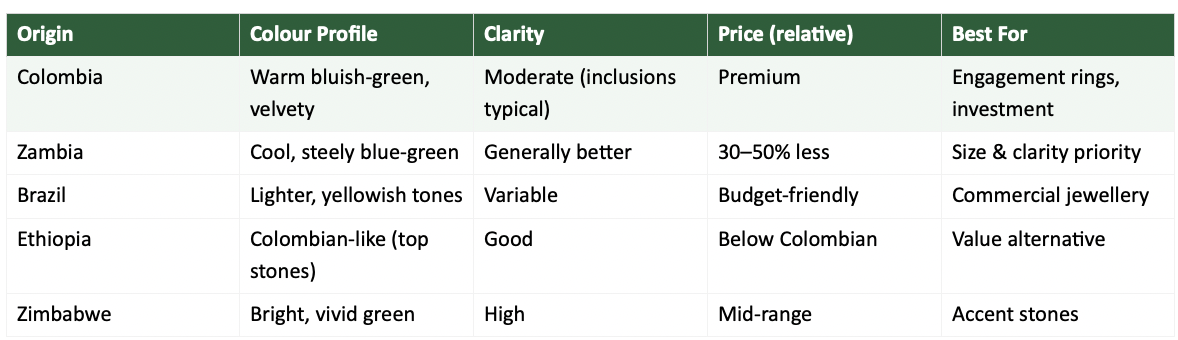
Understanding how Colombian emeralds compare to other major sources helps you make an informed purchase decision. Below is an expert overview of each origin and a summary comparison table.
Colombian Emeralds vs Zambian Emeralds
Zambia has become the world's second-largest emerald producer and offers compelling value. Key characteristics:
Cooler, bluish-green colour sometimes described as "steely" caused by higher iron content
Generally better clarity than Colombian stones, with fewer surface-reaching inclusions
Typically 30–50% less expensive than comparable Colombian stones at equivalent carat weight
Excellent option for buyers prioritising size and clarity over the classic Colombian warm colour profile
Best for: Buyers prioritising eye-clean clarity, larger carat size on a defined budget, or a cooler colour aesthetic.
Colombian Emeralds vs Brazilian Emeralds
Brazil was once a major emerald source, but production has declined significantly. Characteristics:
Wide range of quality, from commercial to fine
Often lighter in tone than Colombian or Zambian stones
Can include yellowish secondary hues, reducing desirability for fine jewellery
Generally the most budget-friendly of the major sources
Best for: Commercial jewellery where budget is the primary constraint.
Colombian Emeralds vs Ethiopian Emeralds
Ethiopia is the newest significant emerald source, generating excitement since commercial production began around 2016. Characteristics:
Top specimens can display Colombian-like colour warm and vivid
Generally good clarity
Limited long-term track record in resale and investment markets
More affordable than Colombian stones of similar appearance
Best for: Buyers seeking Colombian-like colour aesthetics at a lower price point, who are less focused on investment value or provenance prestige.
Other Origins: Zimbabwe, Afghanistan, Madagascar
Zimbabwe produces bright, vivid stones with high clarity excellent for accent stones and commercial use. Afghan (Panjshir) emeralds share geological similarities with Colombian stones and are gaining collector interest. Madagascar produces variable quality, mostly commercial grade.
When Does Colombian Origin Actually Matter?
Origin is not always the deciding factor. Here is an honest guide to when Colombian provenance significantly impacts your decision and when it matters less.
Colombian Origin Matters Most When:
Investing or collecting: For stones intended as investments or for serious collections, Colombian origin adds demonstrable value and liquidity. Colombian stones dominate the top lots at Sotheby's and Christie's jewellery auctions.
Seeking the classic colour: If you specifically want the warm, velvety green that defined emeralds for centuries the colour that appears in royal crowns and museum collections Colombian stones are the only reliable source.
Resale considerations: Colombian stones consistently achieve better resale values and broader international market appeal than comparable stones from other origins.
Gifting significance: For engagement rings and major milestones, Colombian origin adds a layer of meaning and provenance that matters to many buyers.
Colombian Origin Matters Less When:
Beauty is the priority: A fine Zambian emerald can be extraordinarily beautiful. If you simply want a stunning stone for jewellery and are not focused on investment value, consider the individual stone first.
Clarity is paramount: If you strongly prefer a very eye-clean stone with minimal inclusions, African sources (Zambia, Zimbabwe) may offer better options at a given price point.
Budget is fixed: A Zambian or Ethiopian stone of comparable appearance will cost significantly less, allowing you to prioritise setting quality or carat size.
Our Recommendation
For engagement rings and fine jewellery where the stone will be worn for a lifetime, we generally recommend Colombian emeralds for their unmatched colour profile and enduring value. However, a fine Zambian emerald can be an excellent choice for buyers who prefer cooler tones or prioritise clarity. The key is always to evaluate the individual stone not origin alone. We are happy to show you stones from multiple origins side by side.
How to Verify Colombian Emerald Origin: What Certification Means
"Colombian origin" is a claim that requires independent verification not just a dealer's word. Confirming origin requires laboratory analysis by a recognised gemological institution. Here is what that involves:
Inclusion analysis: Colombian emeralds have distinctive inclusion types three-phase inclusions (solid, liquid, and gas), calcite, and pyrite that differ markedly from African stones. Expert gemologists can identify these under magnification.
Trace element spectroscopy: Advanced spectroscopy (LA-ICP-MS and EDXRF) reveals the chemical fingerprint unique to each origin. Colombian stones have characteristic chromium and vanadium ratios without the high iron of African sources.
UV fluorescence patterns: Different origins produce characteristic fluorescence responses under ultraviolet light another tool laboratories use to confirm provenance.
Always request origin certification from a reputable laboratory for any significant Colombian emerald purchase. Credible laboratories include Gübelin (Switzerland), SSEF (Switzerland), GRS (Switzerland/Thailand), and CDTEC (Colombia). Our team can guide you through the certification process and explain what any lab report means for the stone's value.If you are considering a Colombian emerald for an engagement ring, explore our certified loose Colombian emeralds — every stone in our collection comes with full laboratory documentation.
Frequently Asked Questions
Why are Colombian emeralds more expensive than Zambian emeralds?
Colombian emeralds command a premium primarily because of their distinctive warm colour profile a velvety, slightly bluish-green caused by chromium and vanadium without the iron that gives Zambian stones a cooler appearance. This colour has been the global standard for emerald quality for five centuries. Colombian stones also carry greater historical prestige, stronger investment track records, and are generally rarer at fine quality grades. Comparable Colombian and Zambian stones of the same carat weight can differ in price by 30–50% or more.
How can I tell if an emerald is genuinely from Colombia?
Visual inspection alone even by an expert cannot reliably confirm Colombian origin. The only reliable method is laboratory analysis by a credible gemological institution (Gübelin, SSEF, GRS, or CDTEC). These laboratories use inclusion analysis, trace element spectroscopy, and UV fluorescence testing to confirm origin with confidence. Always insist on a laboratory origin report for any significant purchase. Our team can advise on which laboratory is most appropriate for your stone.
Is a Colombian emerald better for an engagement ring than a Zambian one?
Both can make exceptional engagement rings. Colombian emeralds are the preferred choice for their warm, classic colour and investment value — qualities that matter for a ring intended to be worn and passed down for generations. A fine Zambian emerald, however, may offer better clarity at a comparable price, which is a legitimate priority for some buyers. The best approach is to view stones from both origins alongside each other and choose based on the individual stone's beauty. We routinely help clients compare options across origins to find the right match for their vision and budget.
What Colombian mining region produces the best emeralds?
Muzo is generally considered the most prestigious Colombian mining region, known for producing stones with the deepest, warmest colour saturation — the classic "Colombian colour" collectors prize most. Chivor produces slightly lighter, more brilliant stones with better clarity, favoured by those who prefer a brighter appearance. Coscuez (now largely depleted) produces Muzo-like warmth and is increasingly collectible. The "best" region depends on the specific qualities you value in a stone.